Election Offices Answered the Ballot-Initials Rumor in Four Days. Here’s What 524 Governments Posted to Reassure Voters.
In mid-October a false claim spread online that a poll worker’s initials or handwriting on a ballot could get it thrown out. Within four days, 15 county governments in five states posted their own rebuttal, each citing the law that actually decides whether a ballot counts. Nine of the 15 were in North Carolina. Over the past year, 524 governments in 49 states posted 1,101 posts reassuring residents about how their elections work or correcting a specific false claim. Here is what they posted, with examples an election office can borrow before Election Day on Nov. 3.
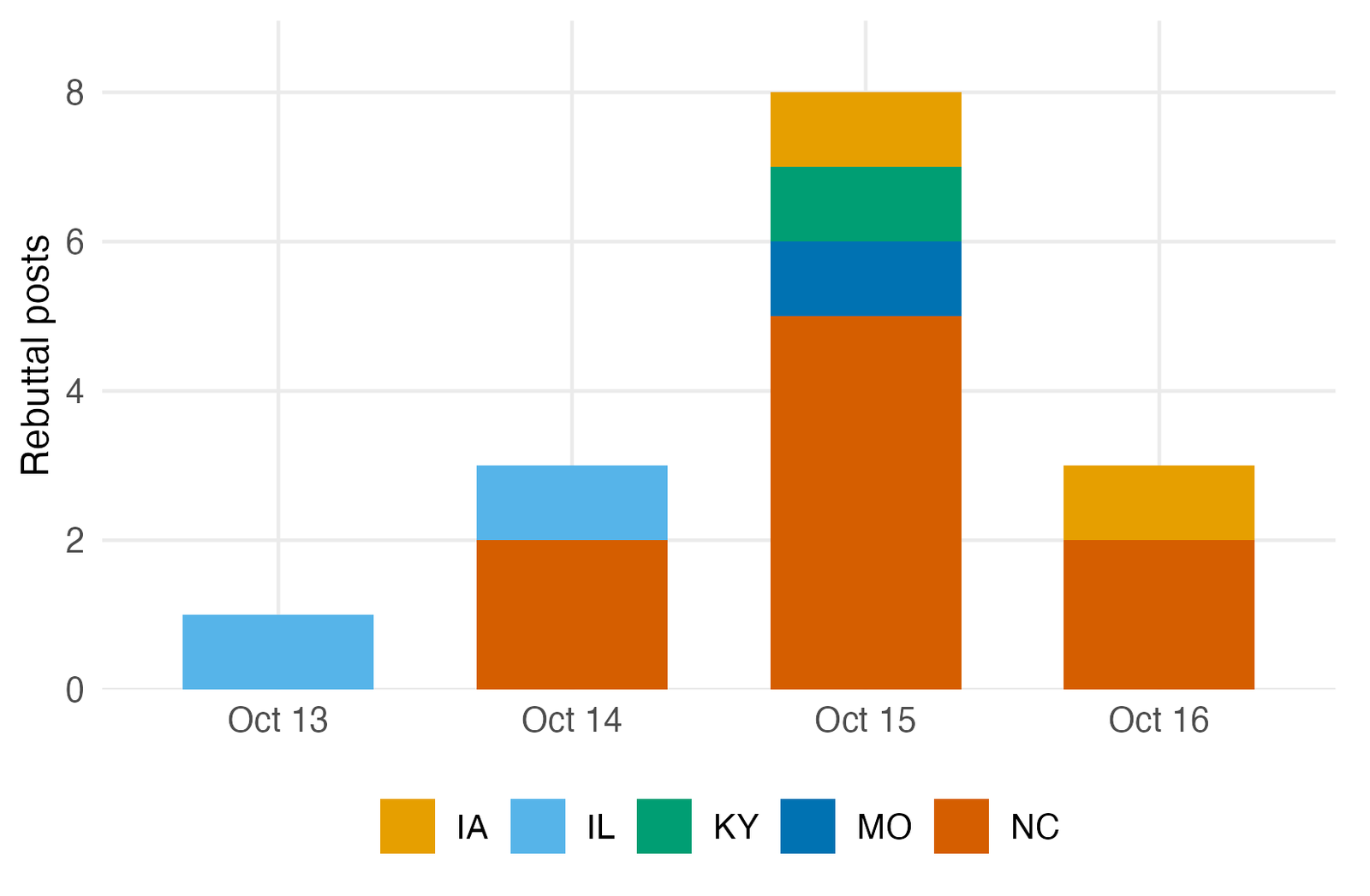
- When the ballot-initials rumor spread, 15 county governments in five states (North Carolina, Iowa, Illinois, Kentucky and Missouri) posted rebuttals within four days, Oct. 13 to 16.
- The rebuttals drew a median of 11 shares. The same governments’ other election posts that October drew a median of three.
- Over the past year, 1,101 posts from 524 governments in all but one state reassured residents about election security or corrected a false claim.
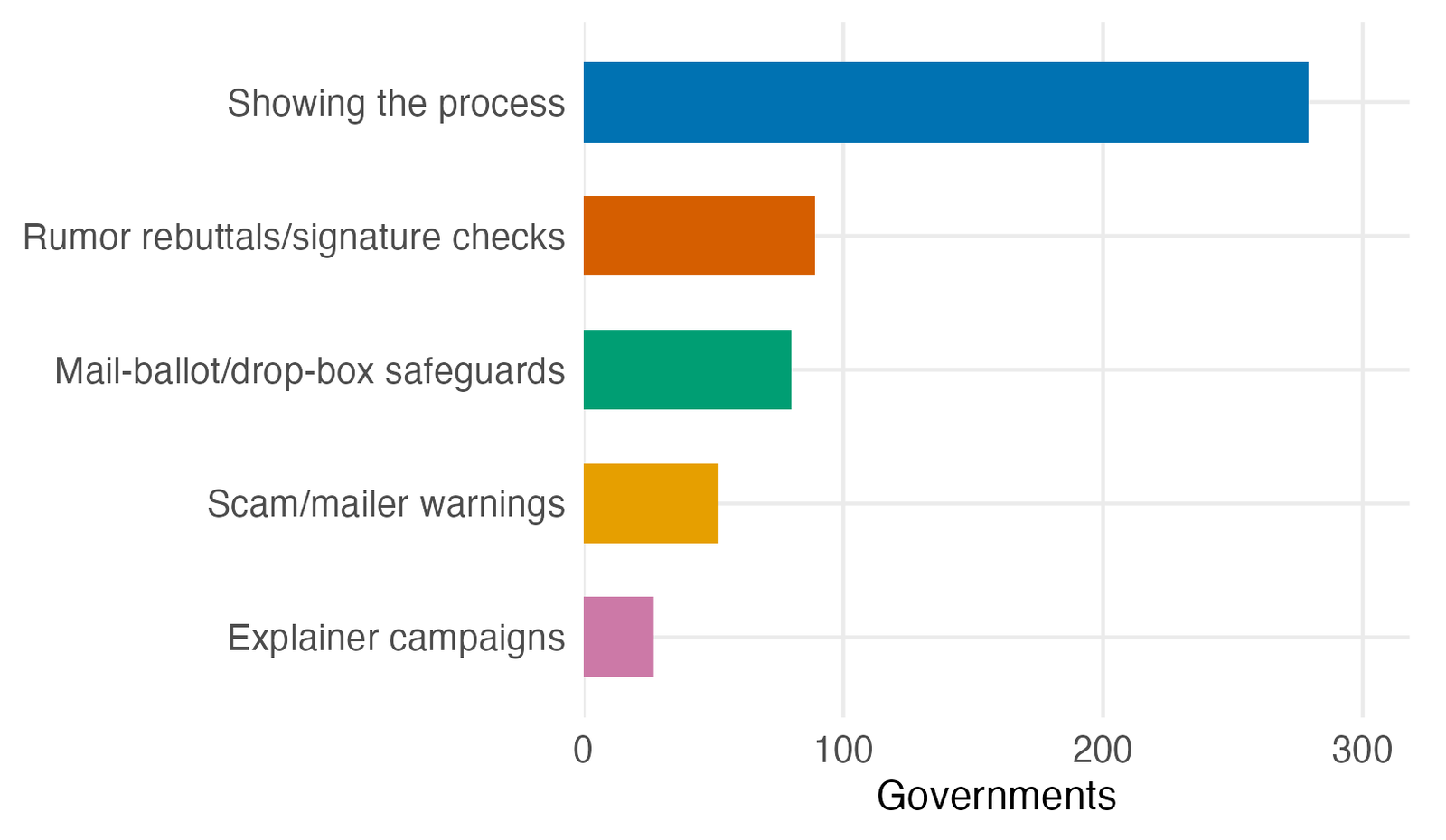
- The most common approach is showing the process: 279 governments in 45 states invited residents to equipment tests, open counts and other steps they can watch.
- The other four themes: rumor rebuttals and signature checks (89 governments), mail-ballot and drop-box safeguards (80), scam-mailer warnings (52) and running explainer campaigns (27).
- Very few governments answered federal pressure directly: 12 governments, 23 posts.
In this report: The ballot-initials rumor · 524 governments, five themes · Answering federal pressure · What to post before Election Day · How we did it
The ballot-initials rumor, answered in four days
The claim was simple and alarming: if a poll worker writes on your ballot, your vote will be thrown out. In Illinois and Iowa, for example, the opposite is true: election judges are required to initial each ballot before handing it to the voter, and the initials are a security step.
County election offices answered with the law that actually decides whether a ballot counts. Grundy County’s Facebook page posted that “Election Judges are REQUIRED to initial your ballot using a RED PEN before providing it to you.” Ringgold County’s Facebook page put it more plainly: “Those required initials do NOT disqualify your ballot.”
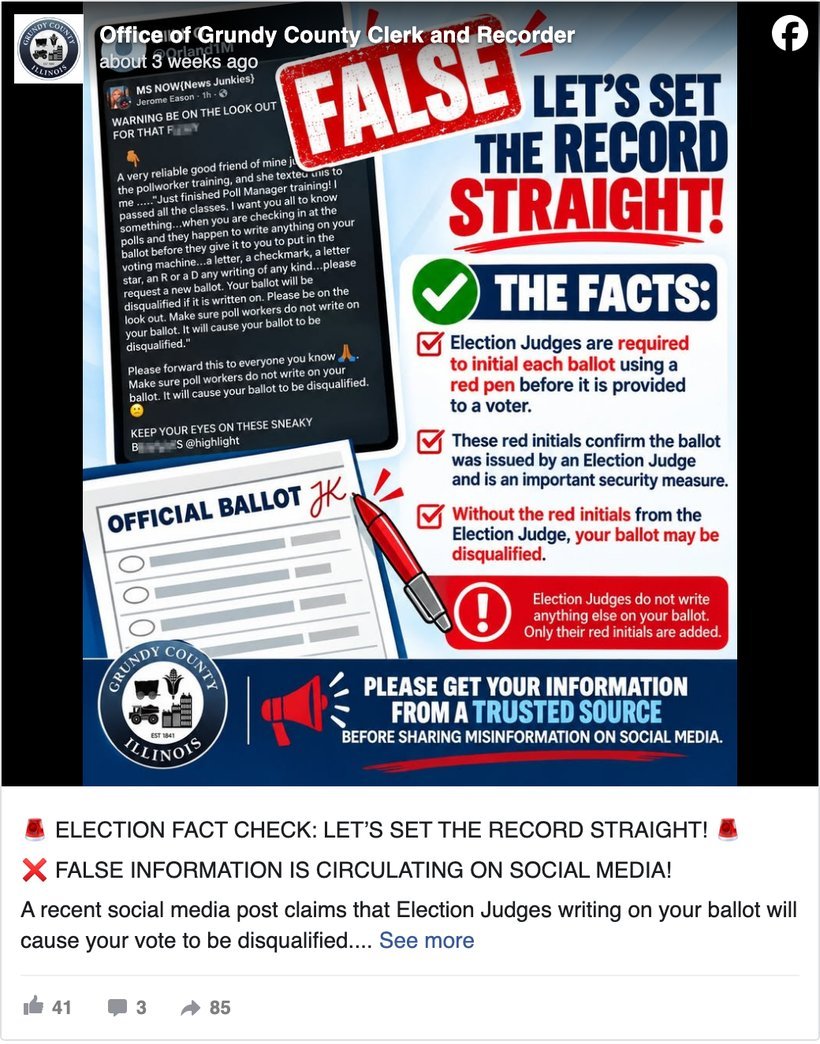
The county clerk’s office put the circulating post on screen, stamped it false, and listed the facts beside it: judges must initial each ballot in red pen, the initials confirm the ballot was issued by a judge, and judges write nothing else on it. It closes by asking residents to get their information from a trusted source.
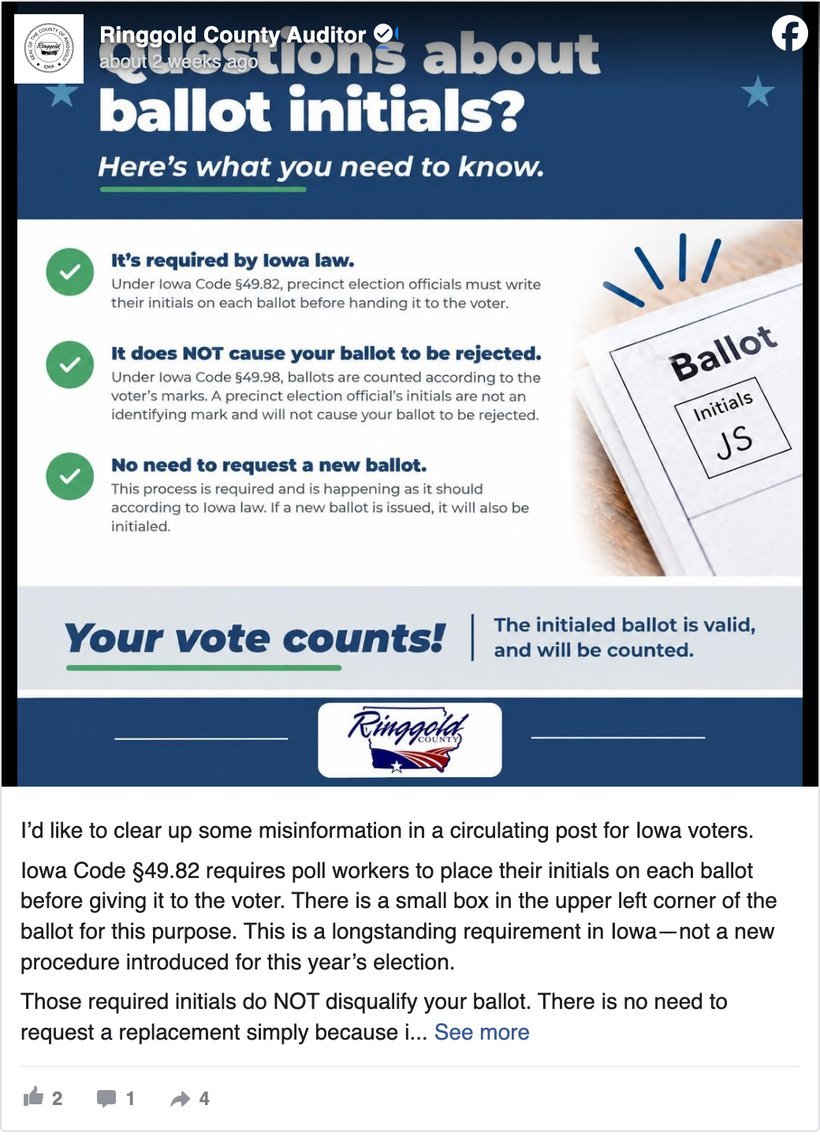
The county auditor named the two sections of Iowa law that govern ballot initials and answered the three questions a worried voter would have: is it required, will my ballot be rejected, and do I need a new one? The graphic ends on the line residents most needed to hear: “Your vote counts!”
Residents passed these posts along. The 15 rebuttals drew a median of 11 shares. The same governments’ other election posts that October drew a median of three.
524 governments, five themes
The rumor wave was one week. Over the past year, 524 city and county governments in 49 states posted 1,101 posts reassuring residents about the safety and security of their elections or correcting a specific false claim. They fall into five recognizable themes.
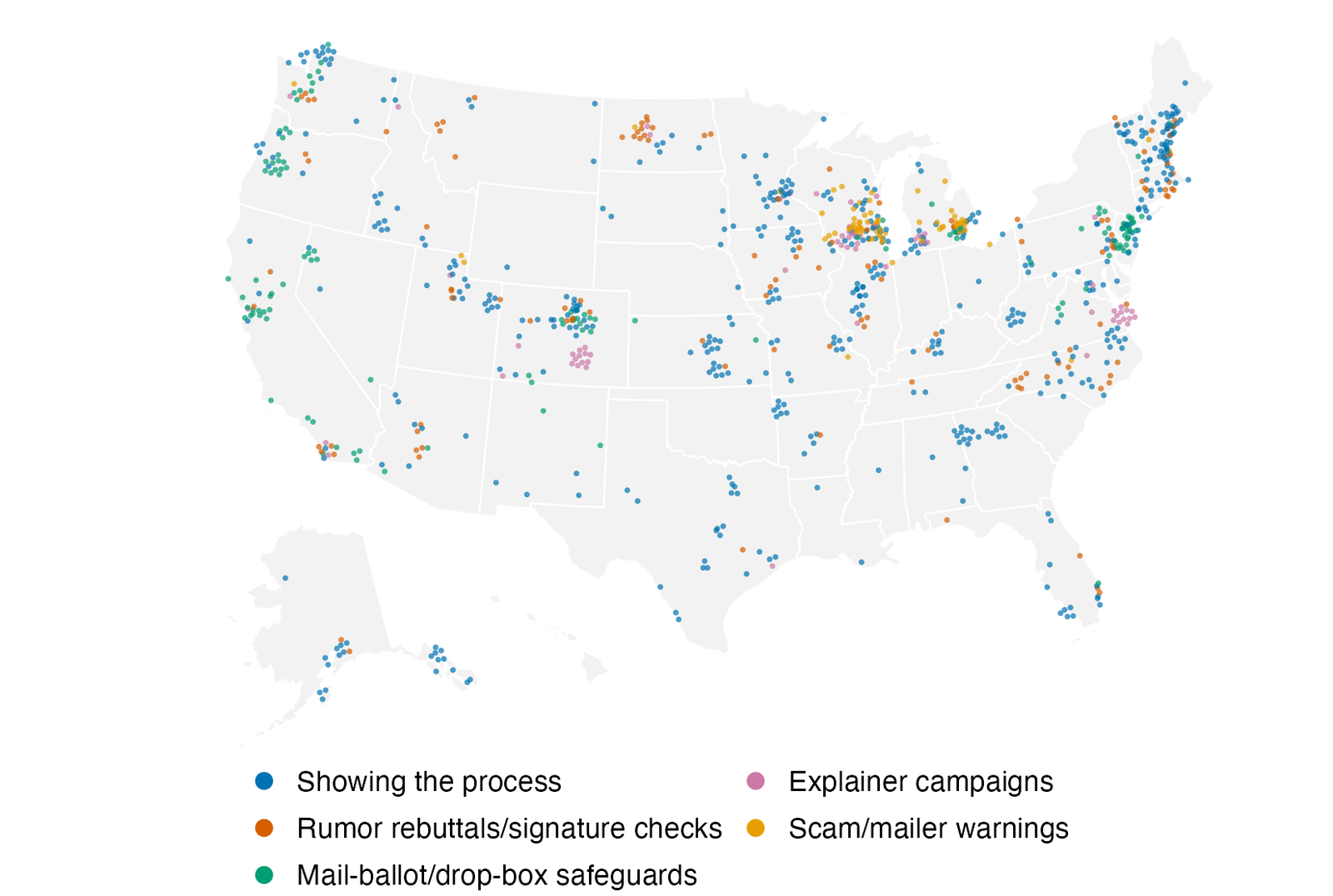
The map shows how widely the practice has spread: small towns in New Hampshire and Vermont, rural counties in the Great Plains, and large urban counties in Georgia and Pennsylvania. The offices posting range from single town clerks to major county election divisions.
1. Showing the process: 279 governments, 45 states
The most common kind of post explains the process instead of just asserting that elections are secure. These governments posted about public equipment tests, open vote counts and other steps residents can watch for themselves. Kalamazoo County’s Facebook page told residents that “voting equipment undergoes a Public Accuracy Test to verify that every ballot is accurately recorded and tabulated”, and invited them to watch.
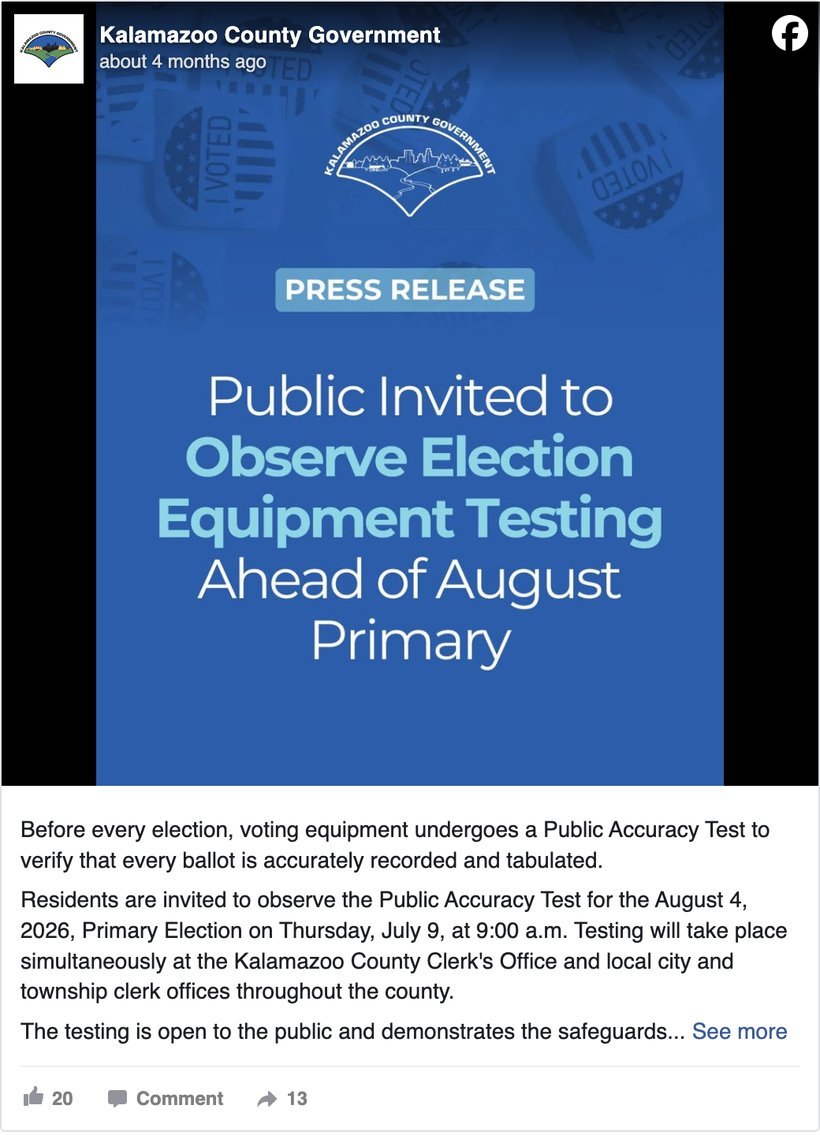
Instead of telling residents the equipment works, the county told them when and where they could watch it being tested, at the county clerk’s office and local clerk offices. A test anyone can attend is a stronger reassurance than any statement.
2. Rumor rebuttals and signature checks: 89 governments, 31 states
This group mixes rumor corrections like the ones in the ballot-initials wave with explanations of how signatures on mail ballots are checked. The City of Melbourne’s Facebook page explained: “The signatures in your voter record are used to verify the signature on the return envelope of your Mail Ballot”, a plain answer to a question election offices get often.
3. Mail-ballot and drop-box safeguards: 80 governments, 18 states
These posts walk residents through the rules for returning a mail ballot. Lehigh County’s Facebook page reminded voters ahead of Election Day: “You can only return your OWN ballot, unless you have been authorized to return someone else’s through a Department of State designated agent form.”
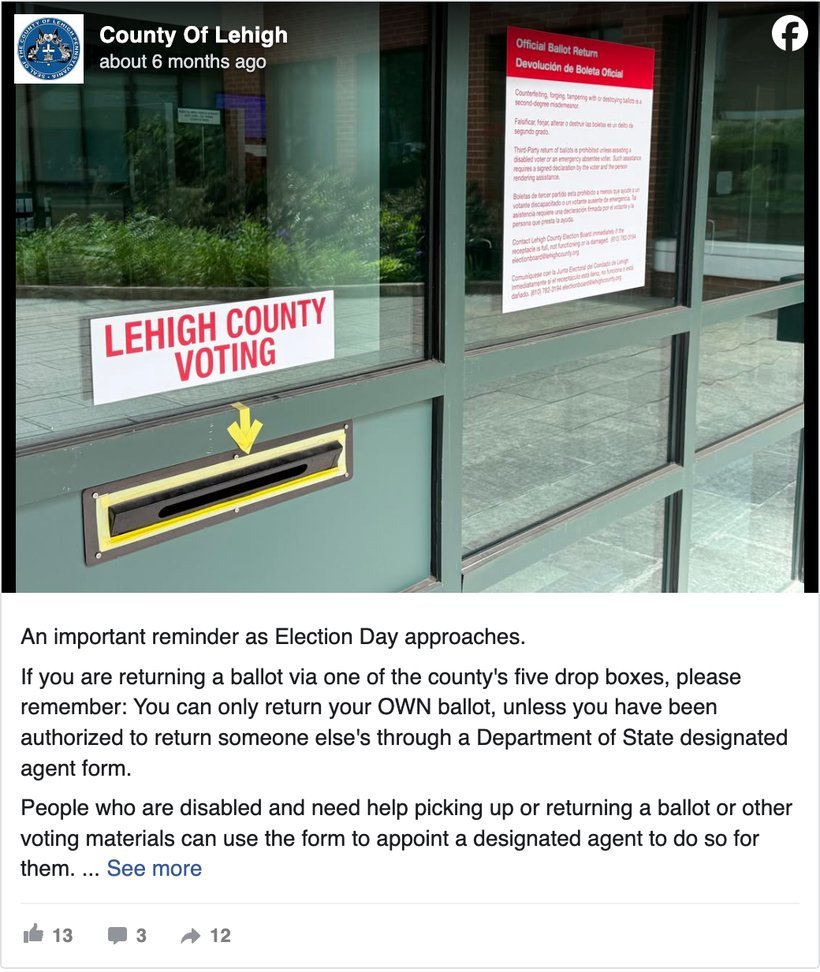
A photo of the actual drop box, the rule in one sentence, and then the part that heads off confusion: voters with disabilities who need help returning a ballot can name a designated agent, and the post explains how.
4. Running explainer campaigns: 27 governments, 15 states
A smaller set of governments built a series of posts instead of a single one. Oshtemo Charter Township’s Facebook page walked residents through the “Journey of a Vote, from verifying voter eligibility, through ballot programming and voting, all the way to certification and post-election audits.”
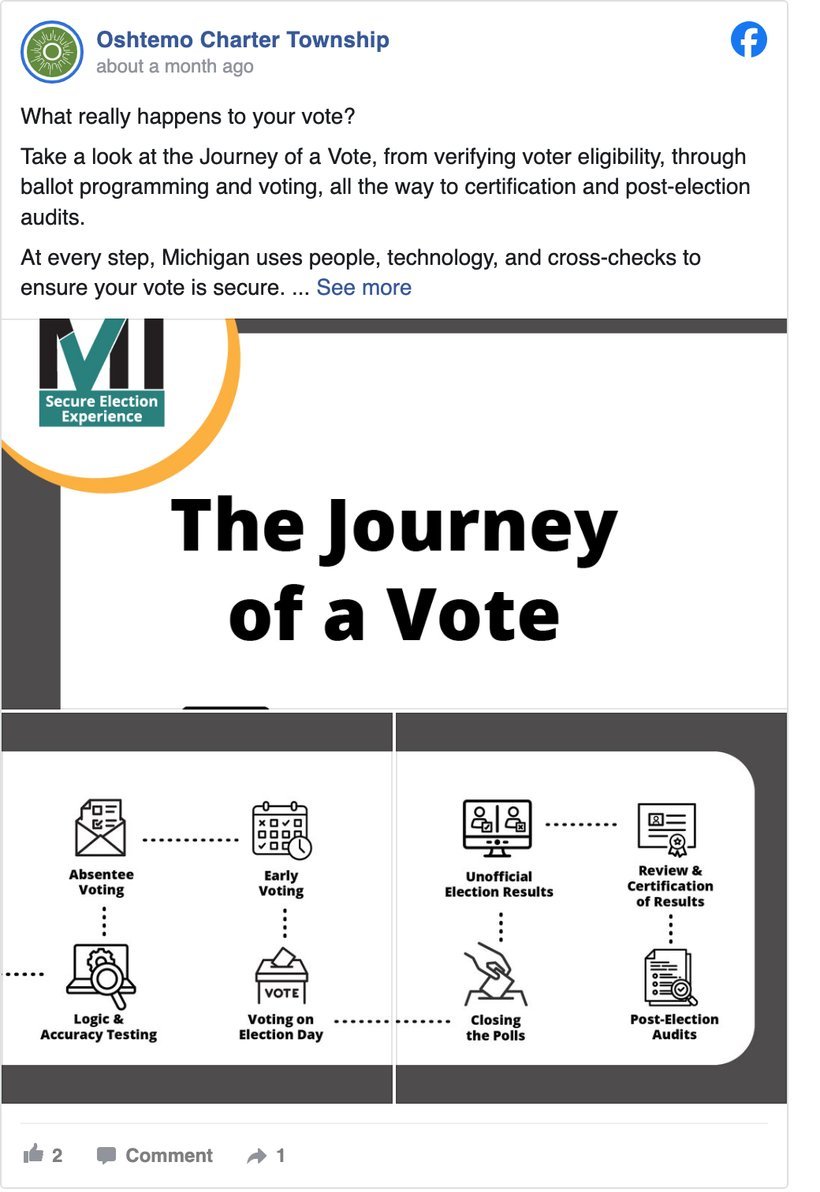
One graphic covers every step from absentee voting to post-election audits, so residents can see where each safeguard sits.
5. Scam-mailer warnings: 52 governments, 11 states
Half of these governments were in Wisconsin. The City of Columbus’s Facebook page told residents: “A third-party organization recently mailed absentee ballot applications to registered voters.” Anyone who had already requested a ballot through the city, it said, could disregard it.
Answering federal pressure
Far fewer governments used the same approach to answer federal actions: demands for voter data, warnings about federal election monitors, and executive orders and court cases on mail ballots. Just 12 governments posted about it at all, 23 posts in total, and 10 of those came from a single Virginia county repeating the same notice.
Jefferson County, Kentucky, moved to dismiss a Justice Department lawsuit demanding its full voter list, and its Facebook page told residents, “We’re fighting every day to protect you and your private information.” Similar posts, answering federal demands for voter data or telling residents about federal election monitors, came from Hudson County, New Jersey; Providence, Rhode Island; and Ingham County, Michigan, whose post addressed Lansing voters directly.
Thurston County, Washington, took the most detailed approach, in July. The county auditor’s office laid out three federal actions residents had been hearing about (a Supreme Court ruling on mail-ballot deadlines, a blocked executive order restricting mail delivery of ballots, and a voter ID bill still in the Senate) and said plainly which ones had changed anything in the county. The auditor’s office wrote: “We want to reassure you: none of these actions change how you vote in Thurston County.”
What to post before Election Day
Every one of these moves comes from posts peer governments have already made. An office with a few days left can borrow them directly:
- Name the rumor and cite the rule. Grundy and Ringgold counties stated the false claim, then quoted the law that governs it. Residents get something they can check, not just a reassurance.
- Invite residents to watch. If your office runs a public test or an open count, post the time and place, as Kalamazoo County did.
- Explain the signature check. A short post on how mail-ballot signatures are verified answers one of the questions election offices hear most.
- Warn about third-party mailers. If residents are getting applications or notices from outside groups, say what they are and whether to act on them.
- Say plainly what has not changed locally. When national news is confusing, a sentence like Thurston County’s (“none of these actions change how you vote”) tells residents what they need to know.
For more on how local governments communicate about elections and answer rumors, see our August reports on local government election communication and how local governments manage rumors and misinformation online. Those reports draw on a different data pull and time window, so their numbers are not directly comparable with the ones here.
How we did it
Frequently asked questions
How are local election offices answering election rumors on social media?
The clearest rebuttals name the false claim and cite the rule that governs it. When a rumor spread in mid-October that poll workers’ initials could disqualify a ballot, 15 county governments in five states posted rebuttals within four days, quoting the law that requires election judges to initial each ballot.
What do local governments post to reassure voters about election security?
Over the past year, 524 governments in 49 states posted 1,101 reassurance or rumor-rebuttal posts in five themes: showing the process, such as public equipment tests and open counts (279 governments); rumor rebuttals and signature checks (89); mail-ballot and drop-box safeguards (80); scam-mailer warnings (52); and running explainer campaigns (27).
What is the ballot-initials rumor?
A false claim that circulated in October 2026 said a poll worker’s initials or handwriting on a ballot could get it thrown out. County offices answered by citing the law that decides whether a ballot counts. In Illinois and Iowa, for example, election judges are required to initial each ballot before handing it to the voter, and the initials are a security step, not grounds for rejection.
See what peer election offices are posting.
GovFeeds collects posts from thousands of local governments so you can find a peer’s rumor rebuttal, equipment-test invitation or drop-box reminder and make your own version.
“An exceptional way for people to look for ideas and comparisons.”