How Local Governments Manage Rumors and Misinformation Online: Inside 540 Real Responses
A rumor that the police department is being disbanded. An AI-generated image of a vandalized Christmas tree. A claim that the county is out of road salt mid-storm. When false information spreads about a community, what do local governments actually do? We pulled every direct response from 1,123,638 public Facebook posts by 4,919 U.S. city and county governments over eleven months — 540 posts in which a government publicly corrected a false claim, rumor, or misleading viral post about its own community — and read them for the how: the formats, the language, the timing, and the infrastructure governments are building around the problem. This report is a field guide to that practice, with real examples throughout.
- Directly correcting a rumor is a specialist practice: 540 posts in eleven months — 1 in every 2,000 — from 8.3% of governments. Participation triples with size (4.7% of small towns, 15.3% of governments over 50,000).
- Five recurring techniques show up across the 540: name the rumor plainly and answer with specifics; fold corrections into emergency operational updates; declare the official channel before it’s needed; build standing fact-check infrastructure; and close corrections with verify-your-sources guidance.
- What they respond to: policing and public-safety incidents lead (185 posts), then weather, roads and emergencies (173), then development and land use (115). A new genre arrived this year: corrections of AI-generated images.
- The practice is spreading: holding the set of governments constant, the response rate rose about 75% from late 2025 into 2026.
- For context, the everyday cousin of this work — scam and impersonation warnings — outnumbers direct rumor response 8 to 1 (4,230 posts from 37% of governments).
In this report: Who does this, and how often · The repertoire: five techniques, with examples · What they respond to · Do the corrections get seen? · The everyday cousin: scam warnings · How we measured it
Who does this, and how often
Answering a rumor head-on — “We are aware of a video circulating…” “There is no truth to rumors that…” “A digitally generated image falsely depicts…” — is one of the least common things local governments do on social media. 540 posts in eleven months, from 407 of 4,919 governments. More than nine in ten governments went the entire year without publishing one.
Adoption of the practice climbs steadily with size:
Governments with 10+ posts in the window, September 2025 – July 2026.
But the examples below make one thing clear: this is not a big-city-only practice. Townships of a few thousand people are doing it — by press release, by plain statement, by folding a correction into the day’s storm update. What follows is how.
The repertoire: five techniques, with examples
Reading all 540 responses, the same five moves appear again and again. Together they amount to an unwritten playbook that hundreds of governments have independently converged on.
1. Name the rumor plainly, then answer with specifics
The most common structure — and the clearest — states the false claim outright rather than alluding to it, then answers with concrete facts: what has happened, what has not, and who confirmed it. No “we’ve seen some things going around.” The claim, then the record.
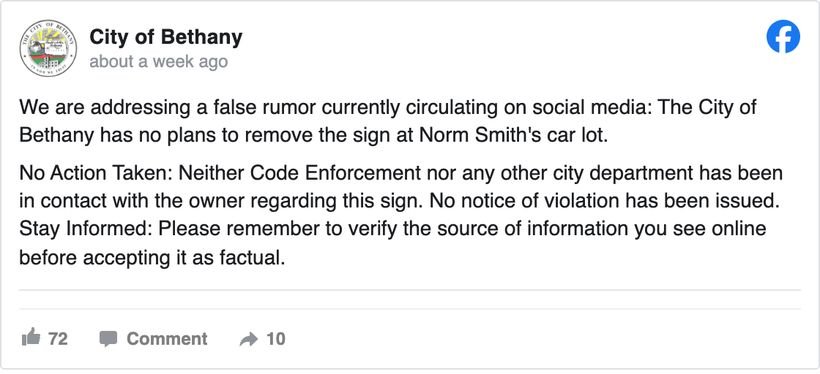
Name the rumor: the city plans to remove a local car lot’s sign. State the record: “Neither Code Enforcement nor any other city department has been in contact with the owner… No notice of violation has been issued.” Close with guidance: “please remember to verify the source of information you see online before accepting it as factual.” Nothing defensive, nothing vague — a complete rumor response in under 80 words.
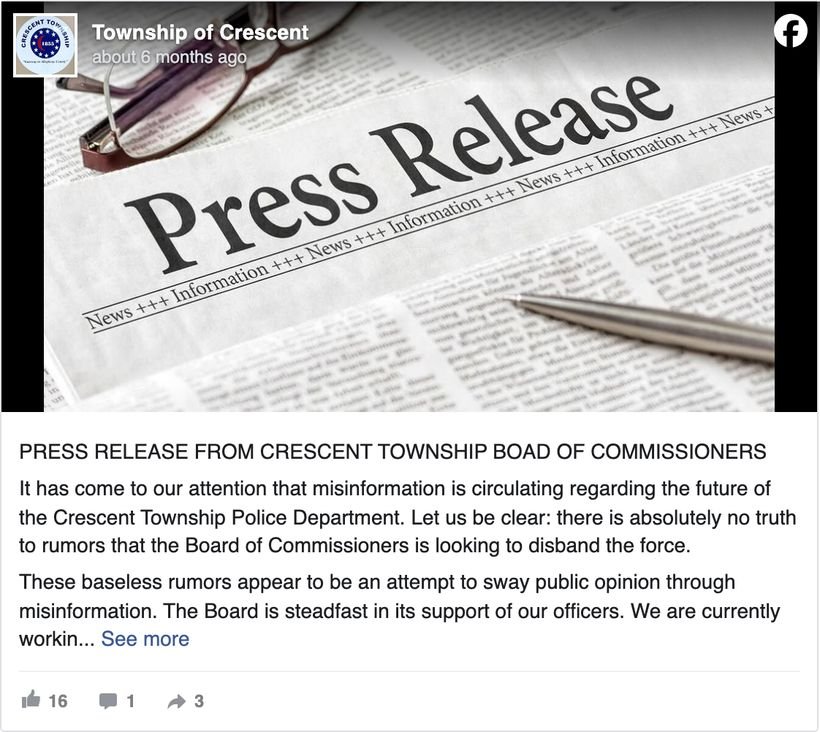
When a rumor spread that the Board of Commissioners planned to disband the police department, this small township answered with the most formal instrument it has: a signed press release, posted to Facebook — “there is absolutely no truth to rumors…” The formality is the message: the post is now the permanent, linkable record that answers the claim every time it resurfaces.
2. Fold the correction into the operational update
During emergencies, many governments don’t give a rumor its own post at all. They correct it inside the update residents are already following — so the correction travels with the information people came for, and the rumor never gets a standalone stage.
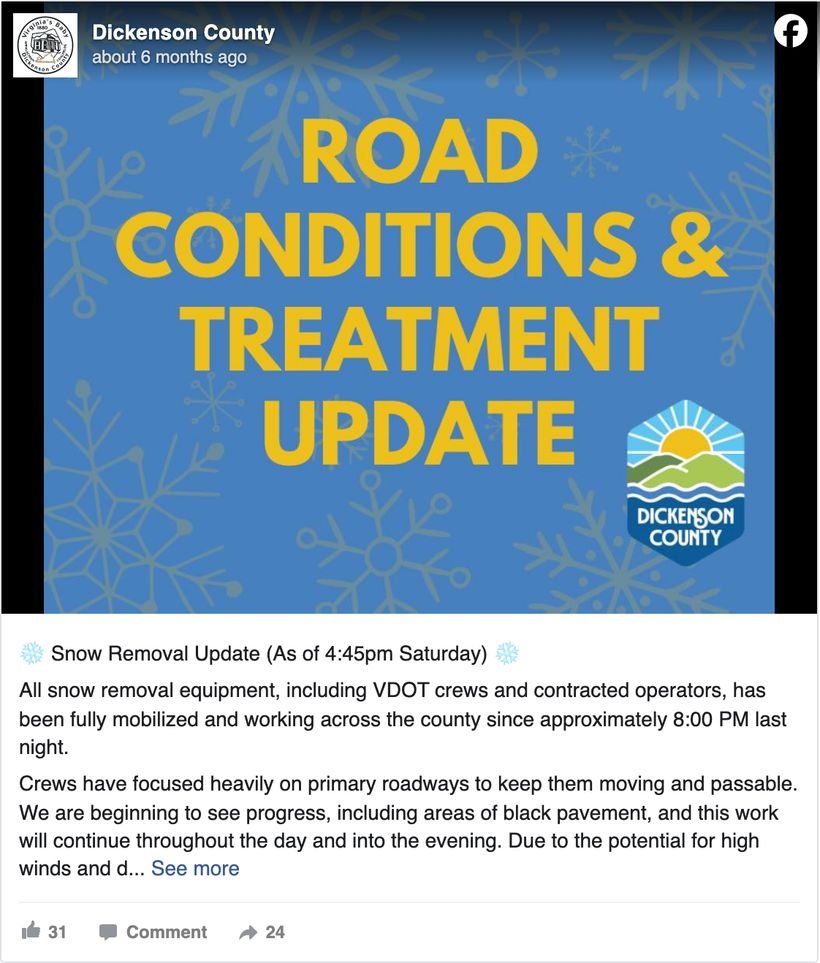
A January snow-removal update leads with what residents need — equipment status, routes — and then addresses “rumors circulating on social media that the county and VDOT are out of salt” with the actual supply picture. Residents forwarded the whole package: the post drew nearly one share per reaction, the pattern of information people pass along to neighbors.
3. Declare the official channel before you need it
106 posts — overwhelmingly during storms and emergencies — explicitly anchored the government’s own page as the place to check: “this page is the official source for updates.” Summerville, South Carolina pinned a single post as the point of truth for confirmed road hazards overnight during a January ice event; Chester, Massachusetts names its Town Hall page and website as “the official sources” for closures and winter maintenance. The move is preventive: it gives residents a habit to fall back on before the first rumor appears, and it gives every future correction a place residents already trust.
4. Build standing infrastructure, not one-off statements
A smaller group of governments has moved past post-by-post response and built a permanent home for corrections.

Monroe’s answer to “a lot of information circulating about City projects, services, and decisions” was structural: launch a standing Fact Check page on the city website, announce it on Facebook, and route future questions there. Arroyo Grande, California runs the same play as “Fact Check Central”; Burleson, Texas runs a recurring, lighter-touch “Rumor Control” series. The correction stops being an emergency measure and becomes a service residents know exists.
5. Close with the habit, not just the fact
The strongest corrections end by teaching, not just correcting. Bethany’s “verify the source of information you see online before accepting it as factual” is the cleanest example; health departments run the same move as recurring myth-vs-fact series; South San Francisco’s guidance during a tense moment was simply “STAY CALM. Avoid spreading misinformation” — followed by the number to call. The one-time correction fades; the habit is what residents carry into the next rumor.
What they respond to
We tagged the 540 responses by subject (a post can carry more than one tag):
Keyword-tagged, overlapping; 108 posts carried none of these tags.
The two big categories are time-critical: a false crime report or a phantom road closure lives and dies inside a news cycle measured in hours, and the responses read accordingly — fast, factual, often from the police or emergency-management page. The third category is the opposite: false claims about what is being built, rezoned, or approved accumulate for weeks, and the responses there tend to be longer statements walking through what has actually been decided.
The practice is also spreading. Holding the panel of governments constant, rumor-response posting ran at 28 posts per 100,000 in October–December 2025 and 49 per 100,000 across January–July 2026 — roughly 75% growth, sustained month over month rather than driven by any single event.
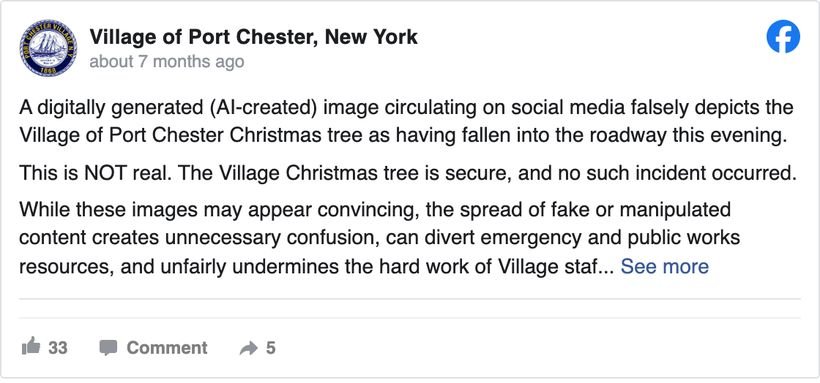
A new genre showed up in this year’s data: corrections of AI-generated images. Port Chester told residents that a “digitally generated (AI-created) image circulating on social media falsely depicts” the village Christmas tree — naming the fabrication technique itself, so residents learn what to look for. Hammonton, New Jersey did the same during a local incident, flagging “AI-generated images and photos/videos from prior incidents” circulating as if current. Small numbers so far, but a category that did not exist in the previous year’s conversation — and a preview of what rumor response will increasingly involve.
Do the corrections get seen?
A brief note, because it is the question every communicator asks before wading in: yes. The median rumor response earns about twice the interactions of a typical government post (12 versus 6), roughly one in eight draws a substantial comment thread, and just over half out-perform their own page’s median. Read that with care — governments respond to rumors precisely when the community is already paying attention, so the numbers describe the moment as much as the post. But the operational takeaway is simple: when a government chooses to answer a rumor, the answer does not disappear into the feed. The audience for the correction shows up.
The everyday cousin: scam and impersonation warnings
The 540 rumor responses sit inside a broader set of 4,770 posts countering false or deceptive information of any kind — 0.43% of everything local government published, from 40% of governments. Most of it is a different, more comfortable practice: warning residents about third-party deception.
Categories overlap slightly; 4,770 unique posts total.
Scam warnings outnumber rumor responses eight to one, and it is easy to see why: the false information comes from scammers, not from anything touching the government’s own decisions, so there is nothing delicate about publishing one. Most are formulaic — and read that way. The interesting practice question is what separates the ones residents actually pass along, and the clearest answer in the data is who delivers them:
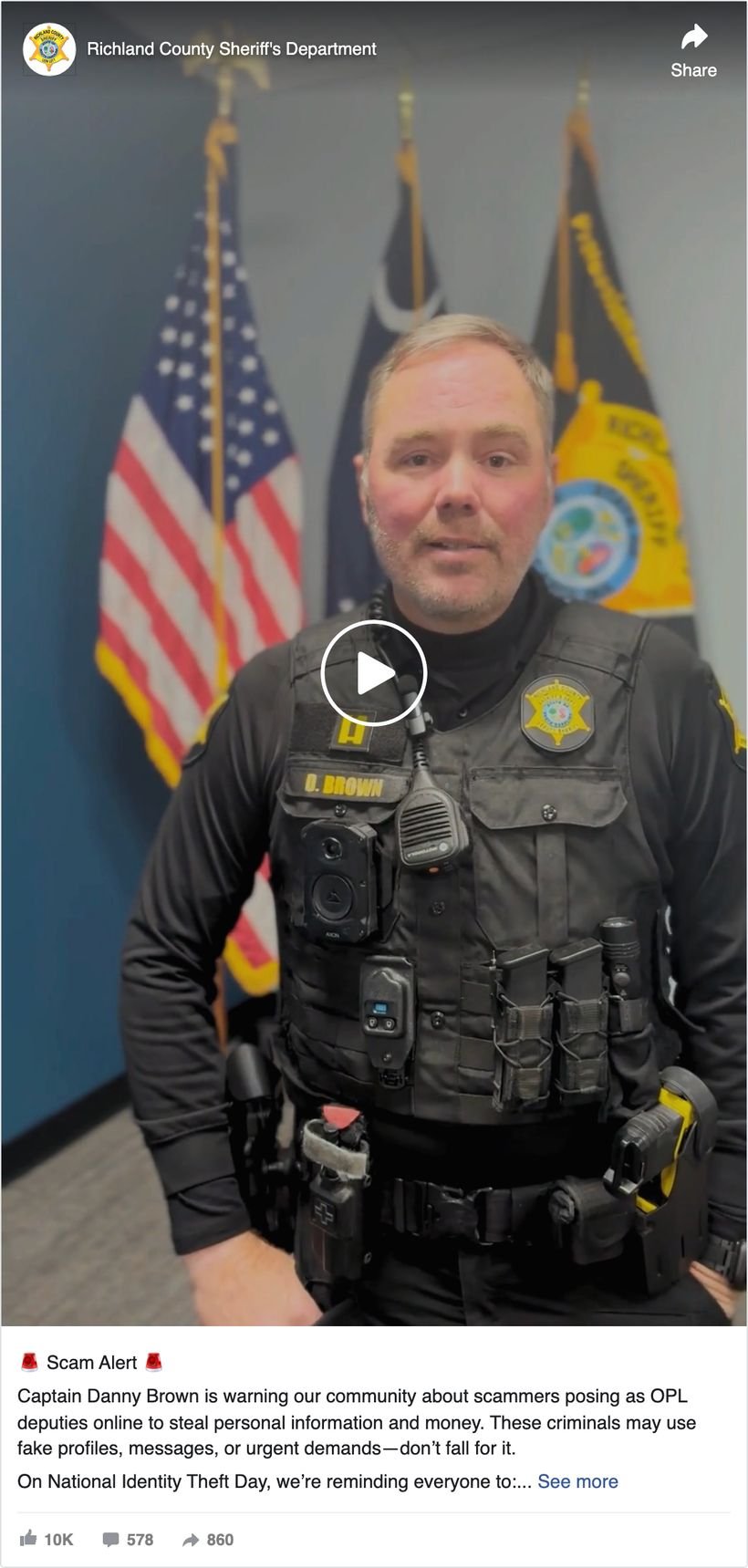
Richland County’s scam warnings are delivered on video by Captain Danny Brown, a recurring, recognizable face — here warning about scammers posing as deputies. The county page’s typical post is modest; this one reached tens of thousands of residents and was shared over 800 times. The format is the lesson: the same warning that reads as boilerplate in a graphic becomes neighborly advice when a known officer says it to camera.
How we measured this
Every number comes from public posts any resident could see.
Frequently asked questions
How do local governments respond to rumors and misinformation online?
Five techniques recur across the 540 direct responses we found: (1) name the rumor plainly and answer with specifics — what has happened, what has not, who confirmed it; (2) fold corrections into emergency operational updates rather than giving the rumor its own stage; (3) declare the official channel before it’s needed (“this page is the official source for updates”); (4) build standing infrastructure like a fact-check page on the government website; and (5) close corrections with verify-your-sources guidance so residents carry the habit into the next rumor.
How often do local governments correct rumors or misinformation online?
Rarely. Across 1.1 million posts from 4,919 U.S. city and county governments over eleven months, just 540 posts — one in every 2,000 — directly corrected a false claim, rumor, or misleading viral post about the government or community, and only 8.3% of governments did it even once. Participation rises with size: 4.7% of towns under 10,000, 15.3% of governments over 50,000. The practice is spreading — the rate rose about 75% across the window among a constant panel of governments.
What false information do local governments correct most often?
Policing and public-safety incidents lead (185 of 540 posts — viral videos, false crime reports, “escaped inmate” rumors), followed by weather, roads, and emergencies (173 — false closures and shelter rumors), and development and land use (115 — what is being built or rezoned). School-threat rumors (72), health myths (65), and taxes and assessments (55) follow. A new genre appeared this year: corrections of AI-generated images.
Do rumor corrections reach anyone?
Yes. The median rumor response earns about twice the interactions of a typical post on the same page, and roughly one in eight draws a substantial comment thread. Part of that reflects the moment rather than the post — rumors and attention arrive together — but the practical point stands: corrections do not disappear into the feed. For comparison, routine scam warnings, the most common counter-false-information content, typically run below their page’s median.
See how communities like yours handle it.
Search real rumor responses, fact-checks, and scam alerts from 5,000+ peer governments — by keyword, state, and population band.
“An exceptional way for people to look for ideas and comparisons.”