How Local Governments Are Talking About Flock Cameras
A year ago, when a city posted about its license plate readers, the post was usually a solved car theft. Today it is just as likely to be a council work session, a transparency portal, a myth-vs-fact graphic — or an announcement that the cameras are coming down. We tracked the conversation across 257 public Facebook posts from 165 city and county governments in 38 states, September 2025 through July 2026. The volume grew 14× over those ten months. And no topic we have measured — not data centers, not elections, not tax reappraisals — draws argument the way this one does.
- The conversation is surging: 4 posts in October 2025; 58 in July 2026. Governments discussing it grew from 2 to 49 per month.
- It is governance-first, not crime-first. Council process, privacy, transparency and removal posts outnumber crime-case results roughly 3-to-1 (160 vs 47).
- Privacy and data-sharing posts are the most contested content we have ever measured: 5.0× the page’s normal engagement, 35% draw 25+ comments, and 32% get more comments than likes — against 1.9% for ordinary posts.
- A removal wave is real and accelerating. Ten governments in our corpus publicly announced ending, deactivating, or not renewing their contracts — five of them in June and July 2026 alone.
- Crime-case results still work: arrest-and-recovery posts run 1.4× the page norm and are applauded (only 6% ratioed), even as the surrounding debate intensifies.
In this report: The surge · What the posts are · The most contested topic we measure · The removal wave · Both sides of the podium · What communicators can take from this · How we measured this
The surge
Flock Safety’s automated license plate readers (ALPRs) sit in thousands of American communities, and for most of their history the official social-media record of them was quiet: an installation announcement, then the occasional recovered vehicle. That changed over this window. National reporting through the spring of 2026 — on audit logs showing out-of-state and federal lookups of local camera data, and on a wave of contract cancellations — turned a procurement item into a public question, and you can watch it arrive on government Facebook pages in real time.
Two things are true at once in that chart. The conversation grew from 4 posts to 58 per month — and its composition barely moved. Governance content (meeting notices, policy discussions, transparency explainers, removal announcements) has been the majority in nearly every month. The common intuition that government pages mostly use these cameras for we-caught-the-suspect content is simply not what the record shows: crime-case results are 18% of the conversation; process and policy are 62%.
What the posts are
The biggest single category is the least dramatic: 64 posts putting Flock or ALPR on a council or commission agenda — work sessions in Fort Collins, study sessions in Greenwood, workshops in South Portland. These are procedural posts and they earn procedural engagement (1.1× page norm) — until residents show up in the comments, which they do more than for any other agenda subject we track: 41% of council-process Flock posts with any recorded comments end up with more comments than likes.
The category that detonates is privacy and data sharing — 47 posts from 38 governments addressing who can query the cameras, how long data is retained, and what happens to it across state lines. Median engagement: 5.0× the page’s normal post. More than a third draw 25+ comments. This is where the national story lands locally, and residents treat it as the main event.
The most contested topic we measure
We benchmark contested-ness two ways: the share of posts drawing a substantial comment thread (25+), and the share that get ratioed — more comments than likes, the signature of an audience that wants to argue rather than approve.
Our June report found data centers were the most comment-heavy subject in local government, with 25.4% of posts drawing 25+ comments. Flock privacy posts beat that at 35.1% — and where a typical government post has a 1.9% chance of being ratioed, a Flock privacy post is ratioed one time in three. Nothing else we have measured comes close. The nearest comparison in our own work is rumor corrections, which get ratioed 5–9% of the time.
The single most extreme example in the dataset is Independence, Kentucky. In late July the city posted a myth-vs-fact carousel — “take a moment out of your busy schedules to learn the truth about flock cameras” — and the live post shows 115 reactions against 1.6K comments: fourteen comments for every like. The city then scheduled a public discussion for August 17 in council chambers. That sequence — explainer post overwhelmed, then a meeting called — is this topic in miniature.
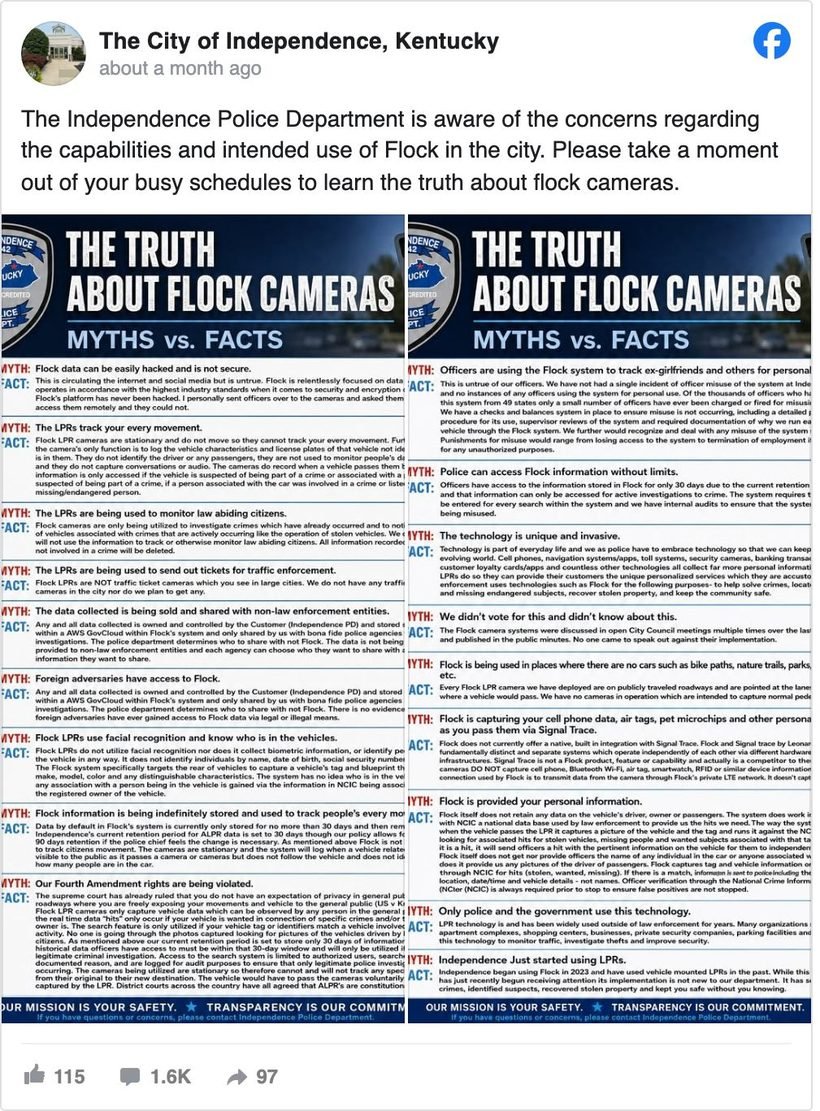
A myth-vs-fact carousel — “MYTH: Independence just started using LPRs” — with “Our mission is your safety. Transparency is our commitment” stamped on every card. The format that works for parking rules and pool schedules met a subject residents wanted to litigate, and the comment thread became fourteen times the size of the applause. The city’s follow-up was the right one: a public discussion, announced for August 17 in council chambers.
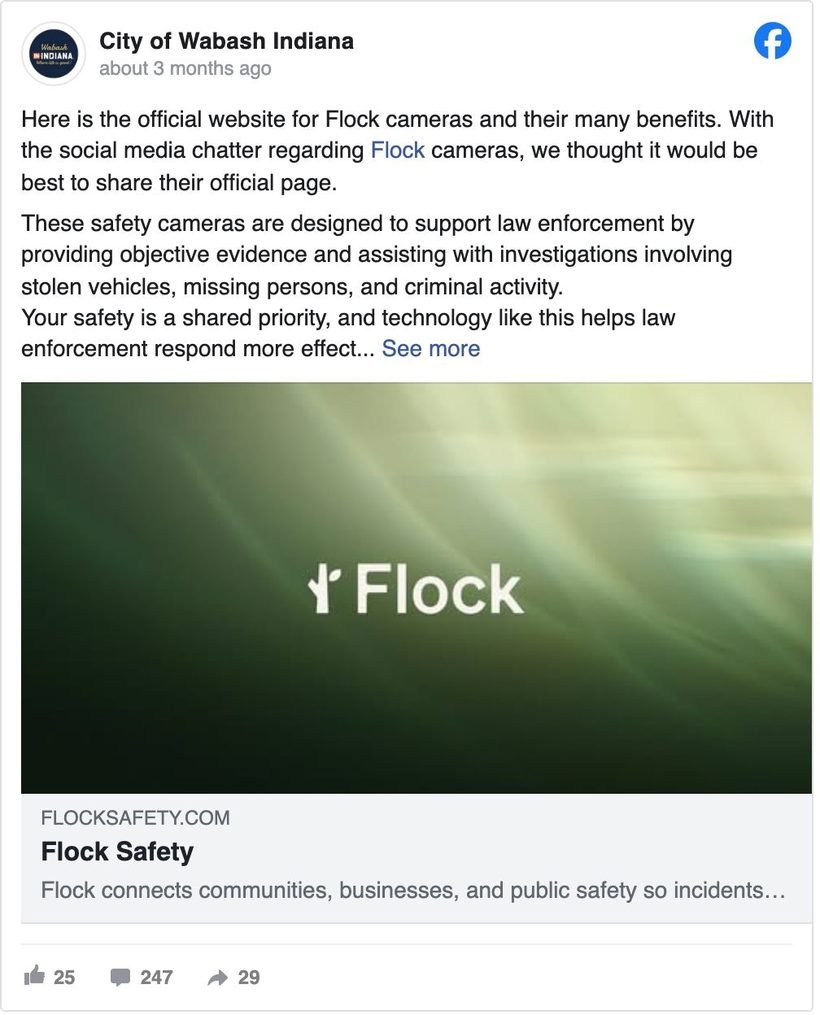
“With the social media chatter regarding Flock cameras, we thought it would be best to share their official page.” A link to the vendor’s own website, offered as reassurance, drew ten comments for every like. The lesson sits in the contrast with League City below: residents in this conversation respond to the government’s own specifics — who queries the system, what is logged, what is prohibited — not to the vendor’s brochure.
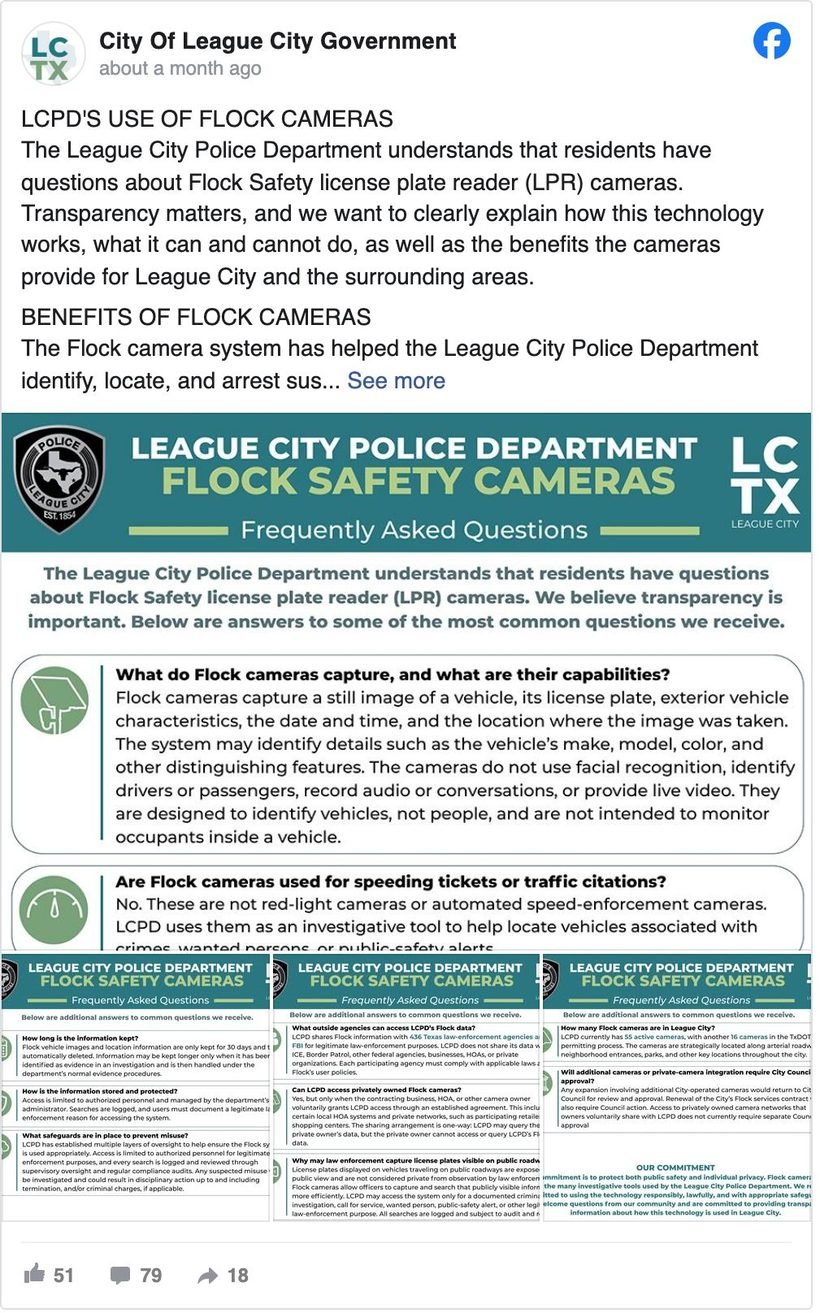
“Transparency matters, and we want to clearly explain how this technology is used.” A card series in the department’s own voice: what safeguards exist, why every search is logged and audited, what happens to misuse (“disciplinary action up to and including termination, and/or criminal charges”). At 51 reactions, 79 comments and 18 shares it was still ratioed — on this topic nearly everything is — but the thread it drew was proportionate, and the post remains the department’s reference answer.
The removal wave
Ten governments in our corpus publicly announced ending, deactivating, or declining to renew their Flock or ALPR programs during the window — and the pace is accelerating: one announcement in late 2025, then five in June and July 2026 alone. In order:
- Hillsborough, NC (Dec): “All Flock Safety cameras contracted by the town have been removed” after commissioners terminated the contract in October.
- Prosser, WA (Jan): press release announcing the city “Deactivates Flock Safety Cameras.”
- Mountain View, CA (Feb): the police chief turned the cameras off “effective immediately,” crediting “feedback we’ve received from concerned residents”; the council then voted unanimously to terminate the contract.
- Port Angeles, WA (Feb): three cameras “turned off and uninstalled” out of “an abundance of caution,” citing the state legislation then moving through Olympia.
- Dane County, WI (Apr): the board amended the budget to remove Flock funding and prohibit further spending, citing “reported and verified abuses of data collected through Flock’s network, including informal data-sharing with federal agencies.”
- Framingham, MA (Jun): chief, mayor and a council subcommittee jointly “made the decision not to renew.”
- South Portland, ME (Jun–Jul): ceased use and data sharing immediately after a council workshop; by June 22, “Flock confirmed all cameras have been removed and there is no active South Portland account.”
- Kaukauna, WI (Jul): “after careful consideration,” did not renew the contract that expired in June.
- Salem, MA (Jul): not renewing and removing the cameras; “insufficient protections for the ALPR data generated by Flock’s systems.”
- Clearwater County, ID (Jul): the sheriff, after “approximately nine months of use,” announced non-renewal.
Washington state deserves its own note: two of the ten are Washington cities, and both posts reference the state’s Driver Privacy Act (SB 6002, signed March 30, 2026), the first comprehensive state ALPR law — a reminder that some of this conversation is being driven from the statehouse, not the council chamber.
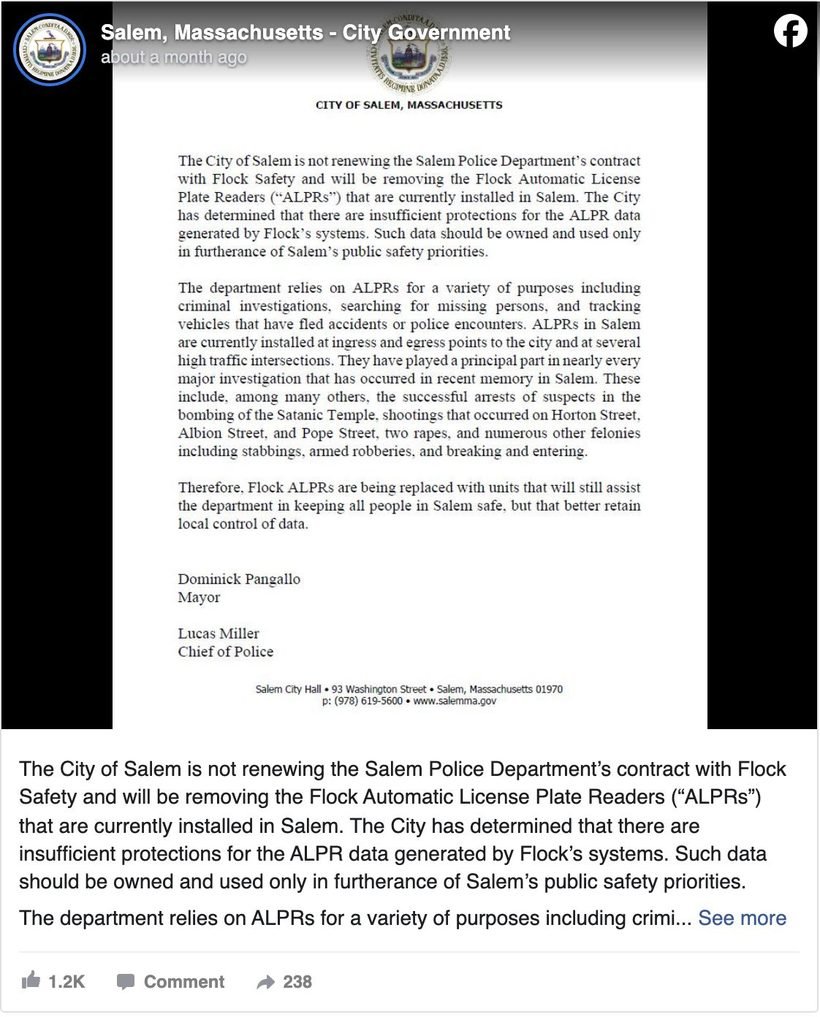
The non-renewal announcement as a model of stating reasons: “The City has determined that there are insufficient protections for the ALPR data generated by Flock’s systems. Such data should be owned and used only in furtherance of Salem’s public safety priorities.” It also credits what the department got from the cameras before explaining the decision — and it earned some of the highest engagement of any post in this dataset, on either side of the question.
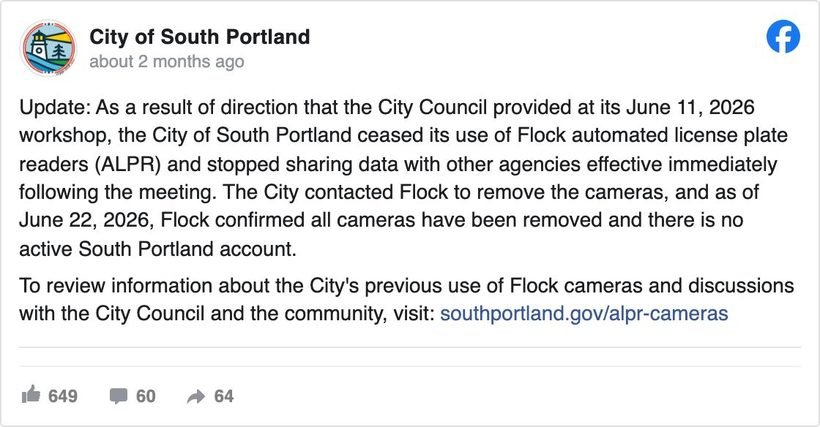
The full arc in one thread: a funding request withdrawn in May, a public workshop in June, use and data-sharing ceased the same night, and a confirmation post — with a dedicated city page for the paper trail. Process posts on this topic are usually 1.1× content; this closure announcement ran far above the page’s norm, and its comment section is calm. Residents reward a decision they watched being made.
Both sides of the podium
The removal wave is real, but it is not the whole story — and a communicator reading only headlines would miss what the rest of the record shows.
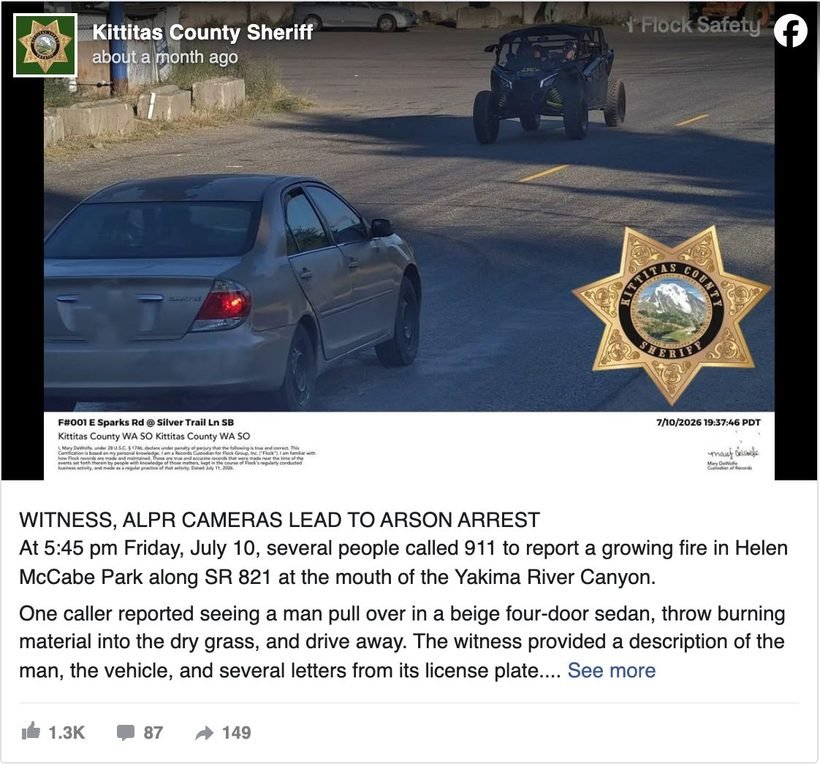
“WITNESS, ALPR CAMERAS LEAD TO ARSON ARREST.” A fire in a dry canyon in July, a witness description with partial plate letters, and the cameras closing the gap. Crime-case results like this run 1.4× the page norm, and only 6% get ratioed — the applause side of this conversation is genuine. Note the construction: the witness comes first, the technology second.
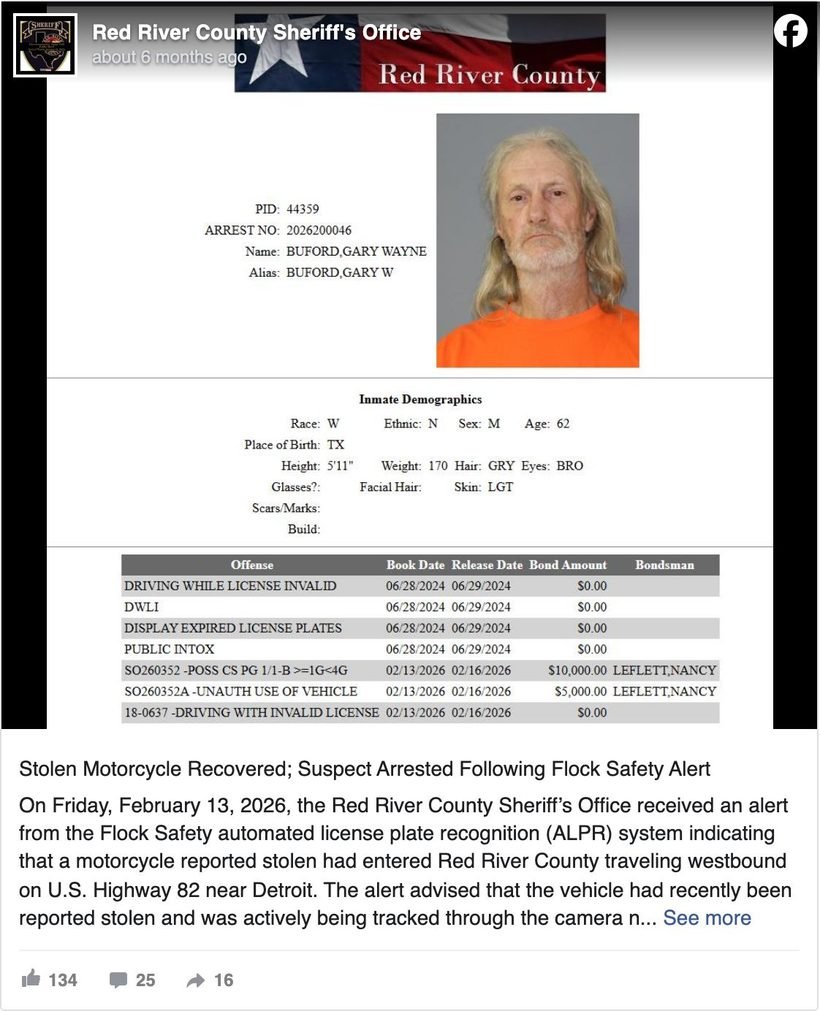
“Stolen Motorcycle Recovered; Suspect Arrested Following Flock Safety Alert.” The workaday version of the same category: the alert, the highway, the stop, the recovery, told in timeline detail. This is what most of the crime-case genre looks like — modest numbers, positive reception, and the technology named matter-of-factly as one link in the chain.
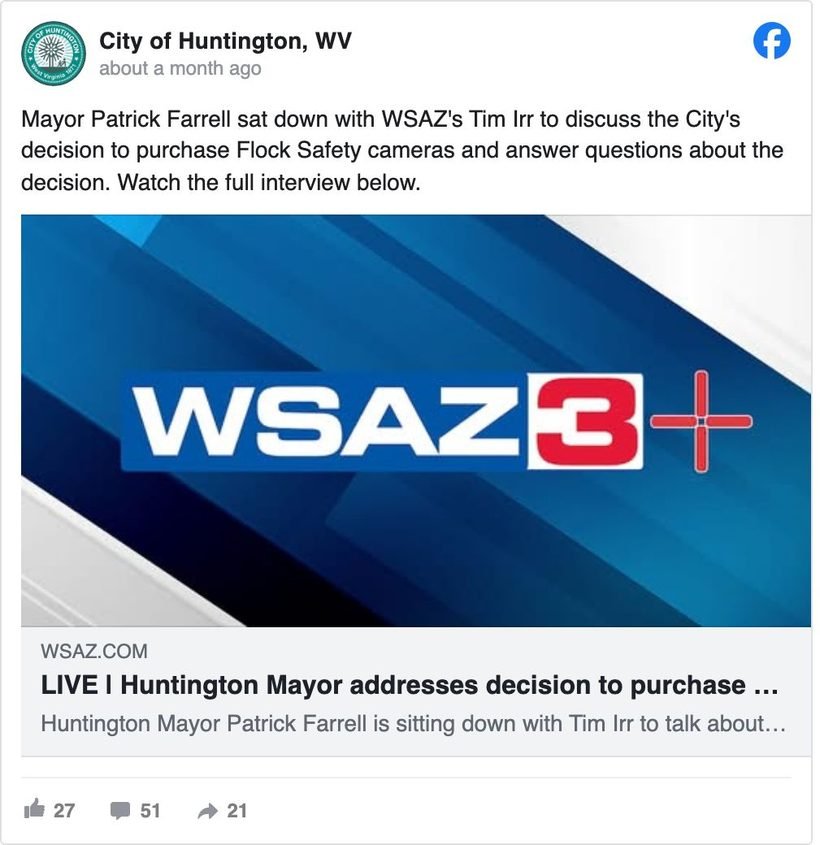
While other cities were announcing removals, Huntington bought — and the mayor sat down with the local station, live, to explain the decision and take questions. 27 reactions, 51 comments, 21 shares: ratioed, like nearly everything substantive on this topic, but the argument happened with the mayor in the room. Buying and defending it on camera is the adoption-side mirror of Salem’s stated-reasons non-renewal.
What communicators can take from this
- Expect the ratio, and stop reading it as failure. On this topic, comments outnumbering likes is the normal condition — it happened to the explainers, the removals, and the purchase defenses alike. The metric that matters is whether the thread is informed by your specifics or by their absence.
- Lead with your own safeguards, not the vendor’s. The clearest contrast in the dataset: League City’s own-voice explainer (what is logged, who audits, what misuse costs) drew a proportionate thread; a link to the vendor’s website drew ten comments per like. Residents are asking what your government does, and only you can answer that.
- Show the process, not just the verdict. South Portland’s workshop-then-decision-then-confirmation sequence produced one of the calmest comment sections in the dataset. Independence’s explainer-first sequence produced the stormiest — and the city’s pivot to a public meeting is the correction the pattern suggests.
- State reasons on the way out, credit results on the way in. Salem named exactly why it was leaving and acknowledged what the cameras had done; Huntington’s mayor took questions on why it was buying. Both were received better than same-category posts that announced without explaining.
- Keep publishing the case results. They are 1.4× content with a 94% applause rate, and they are the concrete half of a debate that otherwise runs abstract. The strongest ones, like Kittitas County’s, put the human witness first and the technology second.
- Watch your statehouse. Washington’s Driver Privacy Act reshaped two of the ten removals in this dataset. If your state is debating an ALPR bill, the vocabulary of your next council meeting is being written there.
How we measured this
Frequently asked questions
How often do local governments post about Flock cameras?
Increasingly often. Across 1.12 million posts from 4,958 U.S. city and county governments, we found 257 posts about Flock or license-plate-reader technology from 165 governments in 38 states over eleven months — growing from 4 posts in October 2025 to 58 in July 2026, a 14× increase. Council-process, privacy, transparency and removal posts outnumber crime-case results roughly 3-to-1.
How do residents react when governments post about license plate readers?
More argumentatively than to any topic we have measured. Privacy and data-sharing posts run 5.0× the page’s normal engagement, 35% draw 25+ comments, and 32% receive more comments than likes — against 1.9% for a typical government post. Crime-case result posts are the exception: 1.4× engagement with only 6% ratioed.
Which cities have removed or not renewed Flock cameras?
In our September 2025 – July 2026 window, ten governments publicly announced ending, deactivating, or not renewing on their own Facebook pages: Hillsborough NC, Prosser WA, Mountain View CA, Port Angeles WA, Dane County WI, Framingham MA, South Portland ME, Kaukauna WI, Salem MA, and Clearwater County ID — five of the ten in June and July 2026. Reasons stated include data-protection concerns, resident feedback, state legislation, and cost-benefit evaluations. Other cities announced the opposite: Huntington WV purchased cameras in the same window, with the mayor defending the decision on live television.
What should a city post when residents raise concerns about Flock cameras?
The pattern in the data favors specifics and process over reassurance. Explainers in the government’s own voice — who can query the system, what is logged and audited, what misuse costs — drew proportionate discussion (League City TX), while a link to the vendor’s website drew ten comments per like (Wabash IN). Cities that showed the decision process — workshop, decision, confirmation, like South Portland ME — saw the calmest reception, and expect comments to outnumber likes regardless: on this topic that is the normal condition, not a failure.
Read how 165 governments handled this before writing your version.
Search “Flock,” “ALPR,” or any topic across 5,000+ city and county governments — by keyword, state, and population band.
“An exceptional way for people to look for ideas and comparisons.”