A Link Costs You Likes, Not Shares
Every local-government communicator has heard some version of it: don’t put links in your posts, the algorithm buries them. And there is something to it — but the advice, as usually given, is wrong in a way that matters. We measured it across 1,124,419 public Facebook posts from 4,958 U.S. city and county governments. A link does cost you engagement. Almost all of that cost falls on likes. The number of people who share your post — the mechanism by which civic information actually travels — is unchanged.
- Linking out is normal. 32.4% of all posts contain a link, and 4,813 of 4,958 governments do it. The typical government links in about a quarter of its posts.
- The penalty is real but smaller than the folklore. A post with a link earns a median 0.75× what the same page’s link-free posts earn. Not a catastrophe — and 39.4% of link posts beat their own page’s normal anyway.
- It is a likes penalty, not a reach penalty. Likes run 0.67×. Shares run 1.00× — dead even. Median shares are 2 with a link and 2 without; the 90th percentile is 16 and 16.
- Link posts are more shareable, proportionally. Shares make up 20.9% of engagement on link posts versus 14.8% without. People forward useful things; they like charming ones.
- You control most of the cost. Link at the end of the post: 0.82×. Link in the opening lines: 0.50×. One link: 0.78×. Three or more: 0.57×.
- You can write past it entirely. A long post carrying a link (1.07×) outperforms a short post carrying none (0.80×).
In this report: How often governments link out · The honest size of the penalty · Where the cost actually lands · What you control · Seven posts the link did not hold back · What to do Monday · How we measured this
How often governments link out
First, the practice itself. Linking is not a fringe habit that a few over-eager webmasters indulge in — it is standard operating procedure.
32.4% of all local-government Facebook posts contain at least one outbound link (364,719 of 1,124,419), and 4,813 of 4,958 governments — 97% — do it at least sometimes. The median government puts a link in 24.9% of what it posts. So roughly one post in three sends residents somewhere, and the typical department does it about once every four posts.
That is worth stating plainly, because the anxiety about links tends to be framed as though linking were a rookie mistake. It is not. It is what nearly every government does, because most of what a government needs residents to do — read the notice, find the shelter, apply for the program, see the map — cannot fit in a Facebook post.
The honest size of the penalty
To measure the cost fairly we compared every link post to its own government’s link-free posts — same page, same followers, same community, same competence. A page that averages 6 interactions and one that averages 600 are each judged against themselves.
Done that way, the median link post earns 0.75× what its page’s link-free posts earn. That is a real penalty: about a quarter of the engagement, gone. But three things sit alongside it that the folklore leaves out. 39.4% of link posts beat their own page’s normal post anyway. 24.0% earn at least double it. And the median is a median — the spread between a well-built link post and a badly built one is far larger than the penalty itself.
Where the cost actually lands
This is the finding that should change how you think about it. Engagement is not one thing. Split it into its parts and the penalty turns out to be extraordinarily lopsided.
Likes fall by a third. Shares do not fall at all. The within-page index for shares is 1.00 — exactly even — and the raw counts say the same thing from a different direction: the median link post gets 2 shares and the median link-free post gets 2 shares; at the 90th percentile it is 16 and 16. Comments sit in between, with 39.3% of link posts drawing at least one comment against 43.9% of link-free posts.
Look at the composition and the point sharpens further. On posts without a link, shares are 14.8% of all engagement. On posts with one, shares are 20.9%. A link post is not just equally shareable in absolute terms — sharing is a larger part of what it earns.
That makes intuitive sense once you say it out loud. A like is an expression of approval, and people do not applaud a boil-water notice. A share is an act of forwarding — you need to see this — and that is precisely what a resident does with information that is useful to someone they know. The posts governments most often attach links to are the useful ones.
So the question “how much does a link dampen engagement?” has a more useful answer than a single number. It dampens the metric that flatters you and leaves alone the metric that distributes you. If the reason you are posting is that residents need to reach something, the link is not working against you.
What you control
The penalty is not a fixed tax. Nearly every input that moves it is a decision you make while writing the post.
Put the link last. A link in the final stretch of the post runs 0.82×, with 42.5% beating their page. A link in the opening lines runs 0.50×, with only 28.6% beating it. Same link, same destination — a 64% difference in outcome based on nothing but where it sits. A reader who meets a URL in the first sentence has been told, before anything else, that the post is an errand.
Include one link, not four. One link: 0.78×. Two: 0.60×. Three or more: 0.57×. If a post genuinely needs four destinations, it is probably two posts, or it is a post that should point at one page that holds the other three.
The format matters more than the link does. A video carrying a link runs 0.96× — essentially parity with an ordinary post, and comfortably ahead of a photo carrying a link (0.75×) or a text post carrying none (0.76×). The link is not what is holding your post back; the absence of anything to look at is.
Where the link goes matters less than you would think, with one exception. Your own .gov site does best at 0.80×, a news or .com site 0.73×, a form or signup service 0.67×. The outlier is the meeting-portal vendor — the agenda-management and livestream platforms — at 0.57×. That is not really about the domain. It is about the fact that a link to next Tuesday’s agenda packet is a link to next Tuesday’s agenda packet.
The one that surprised us: write more, not less
The received wisdom is that a link post should be short and get out of the way. The data says the opposite, emphatically.
Link posts get monotonically better the more you write: 0.50× under 160 characters, 0.61× at 160–400, 0.75× at 400–800, 0.89× at 800–1,500, and 1.07× above 1,500 characters — above parity. Longer link posts beat their page’s ordinary post.
Be careful how you read that, though, and we want to be straight about it: link-free posts also improve with length, and at every single band they stay ahead of link posts. The gap does not close — it widens, from −0.30 at the shortest to −0.63 at the longest. What the chart shows is not that links become free. It is that the amount of context you write swamps the link penalty in absolute terms. A 1,500-character post with a link (1.07×) does better than a 100-character post without one (0.80×). You cannot make the link free, but you can make it irrelevant to whether the post lands.
The practical version: if a link is worth posting, it is worth 150 words explaining why. Write the post so that a resident who never clicks still comes away knowing the thing. The click becomes an option rather than a prerequisite — and, not incidentally, that is also the post people share.
Seven posts the link did not hold back
Every post below carries a link and was forwarded hard anyway. These are Facebook’s public embeds, and the figures quoted are the ones each live post displays — we describe only what is visible in the screenshot.
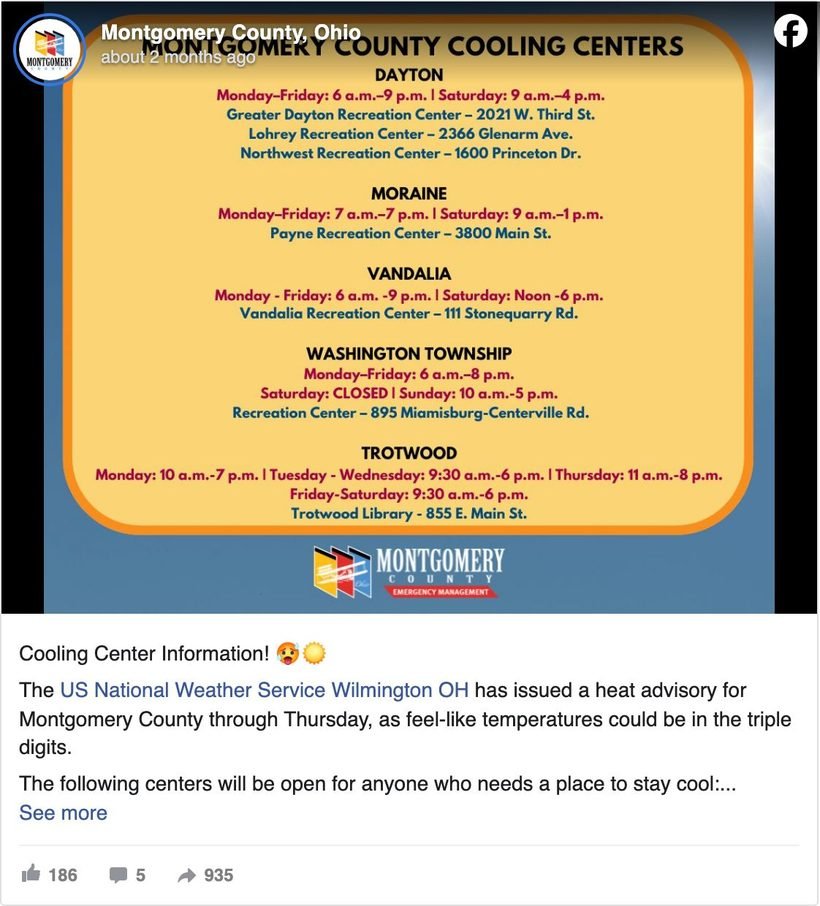
A National Weather Service heat advisory, with a graphic listing every cooling center in the county — Dayton, Moraine, Vandalia, Washington Township, Trotwood — addresses and opening hours included, and the link further down. Residents shared it five times more often than they liked it. That ratio is the whole argument of this report in one post: nobody applauds a heat advisory, and it does not matter in the slightest, because 935 people forwarded it to someone who needed somewhere cool to sit.
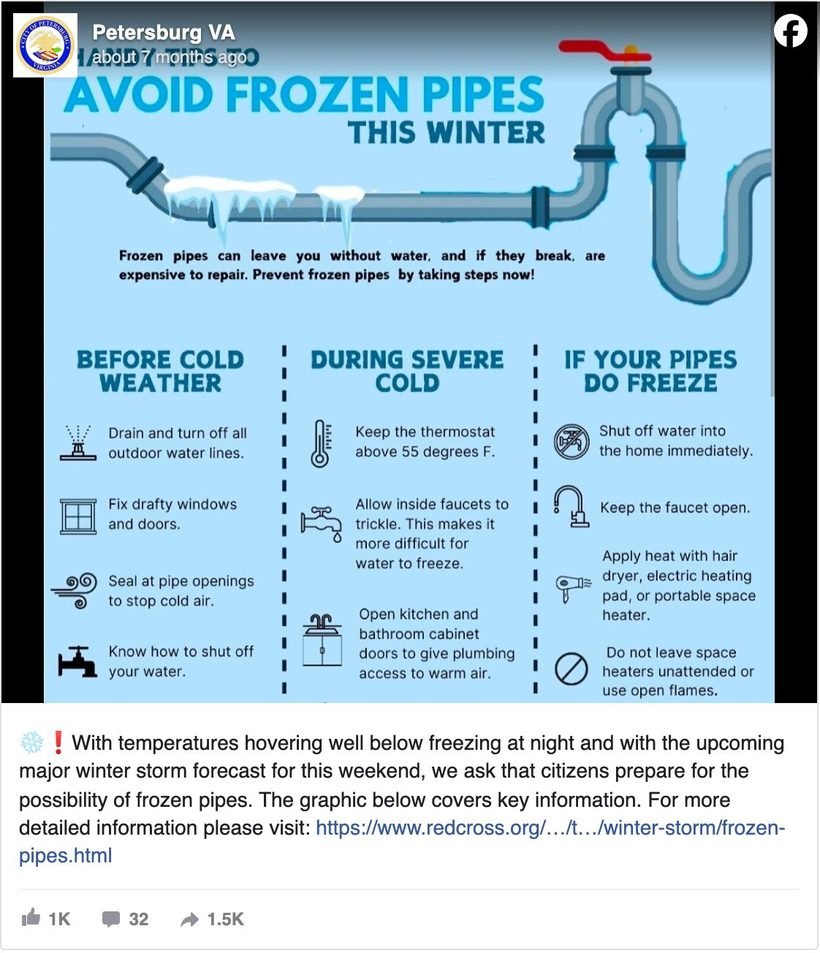
Freezing temperatures, what it means for your pipes, and a link to the detail. More shares than likes again, and both large. The post explains the risk in the post — the link is where you go if you want the full guidance, not the price of admission for understanding that your pipes are in danger tonight.
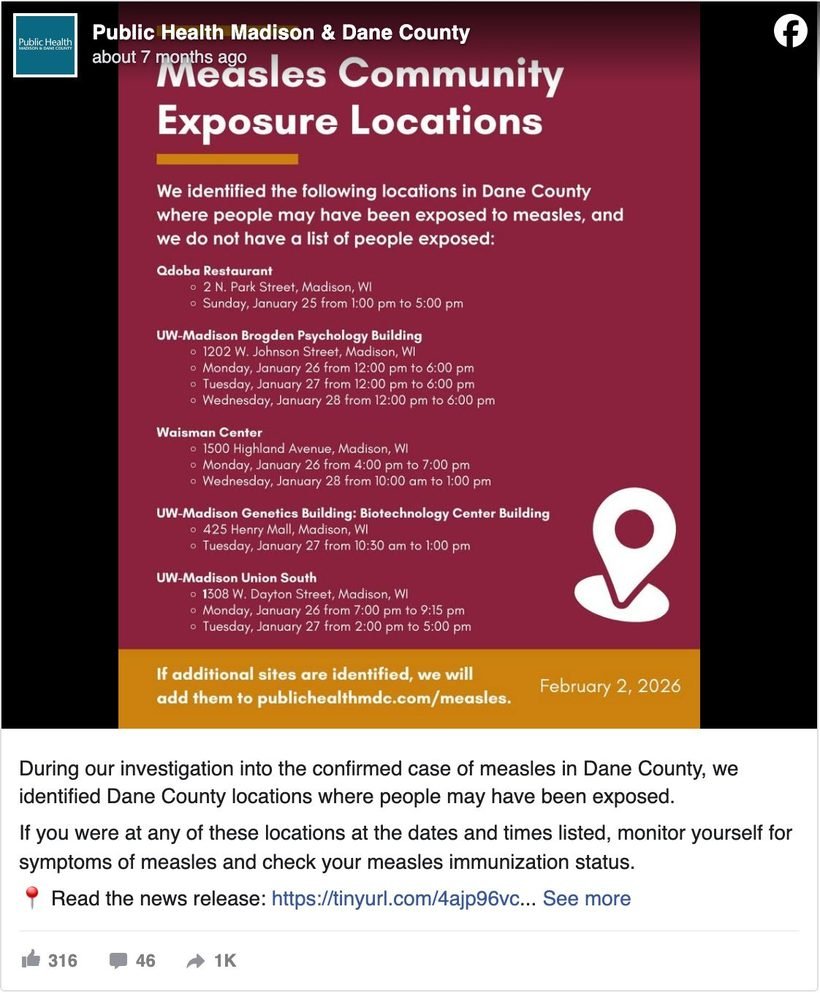
A confirmed measles case and the locations where residents may have been exposed, with “Read the news release” and a shortened link at the bottom. Shares outnumber likes three to one. Note the construction: the exposure information — the part a neighbor needs — is in the post. The link carries the depth.
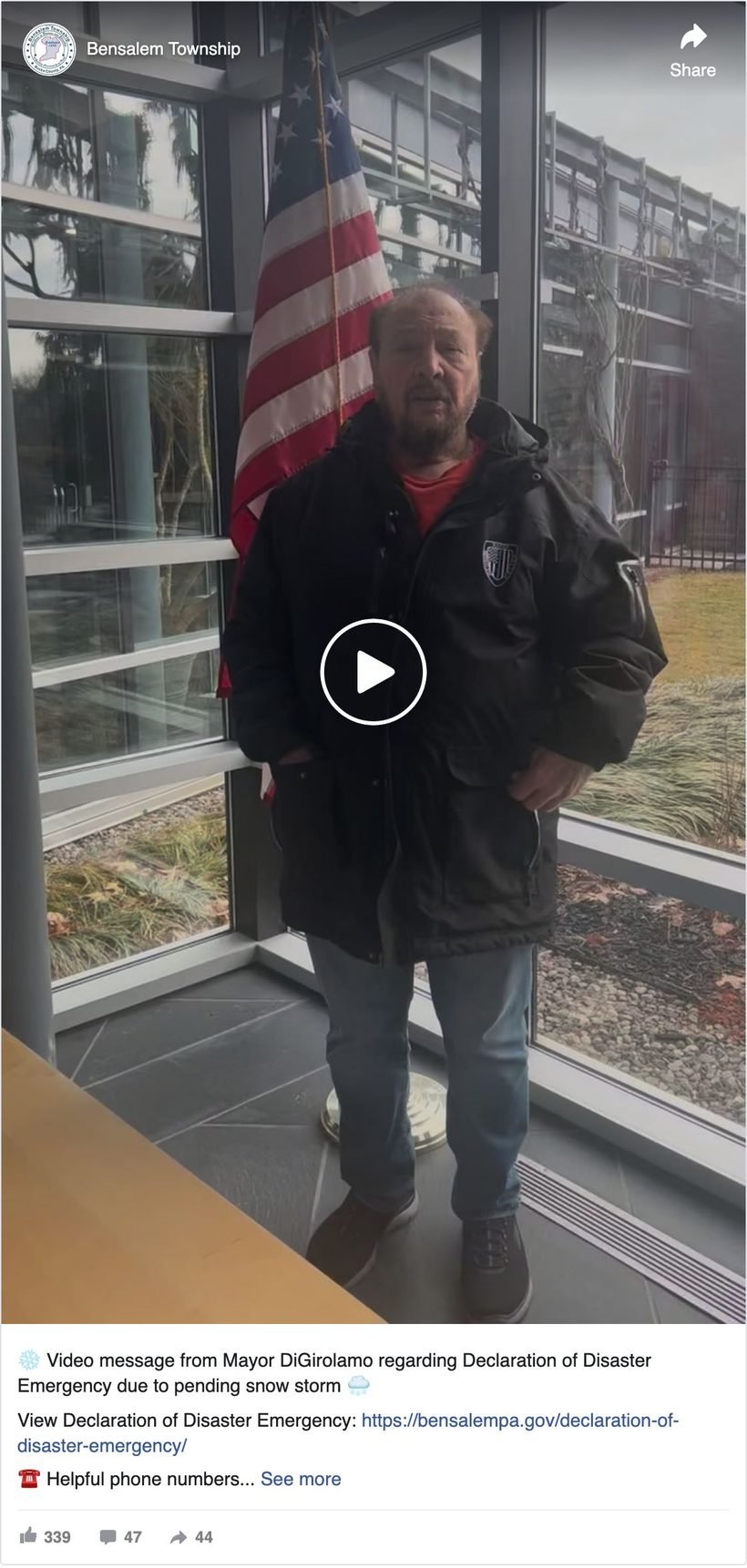
The mayor on camera announcing a disaster declaration ahead of a snowstorm, with “View Declaration of Disaster Emergency” and the township’s own .gov link underneath, plus helpful phone numbers. 339 reactions, 47 comments, 44 shares. This is the 0.96× video finding as a working method: the link is the footnote, and a person is the post.
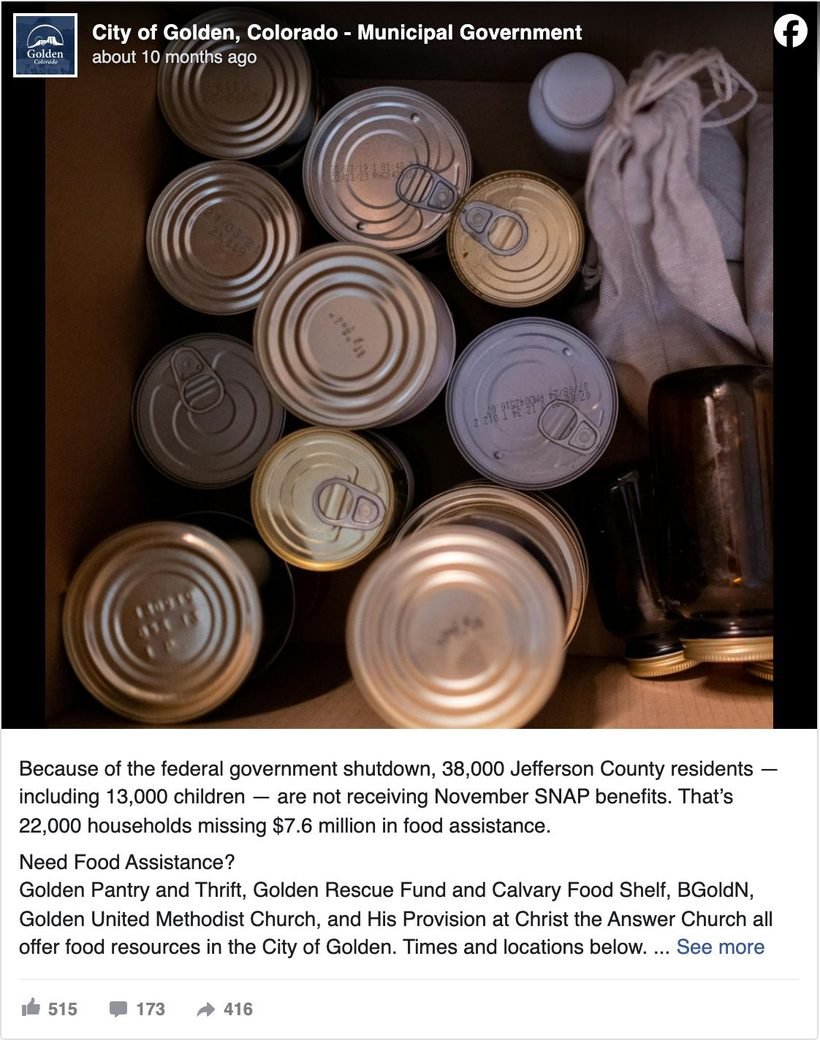
Food resources during the federal shutdown, affecting 38,000 Jefferson County residents. The times and locations are listed in the post, with the link for the rest. A long post — and the length is doing the work, exactly as the length chart predicts.
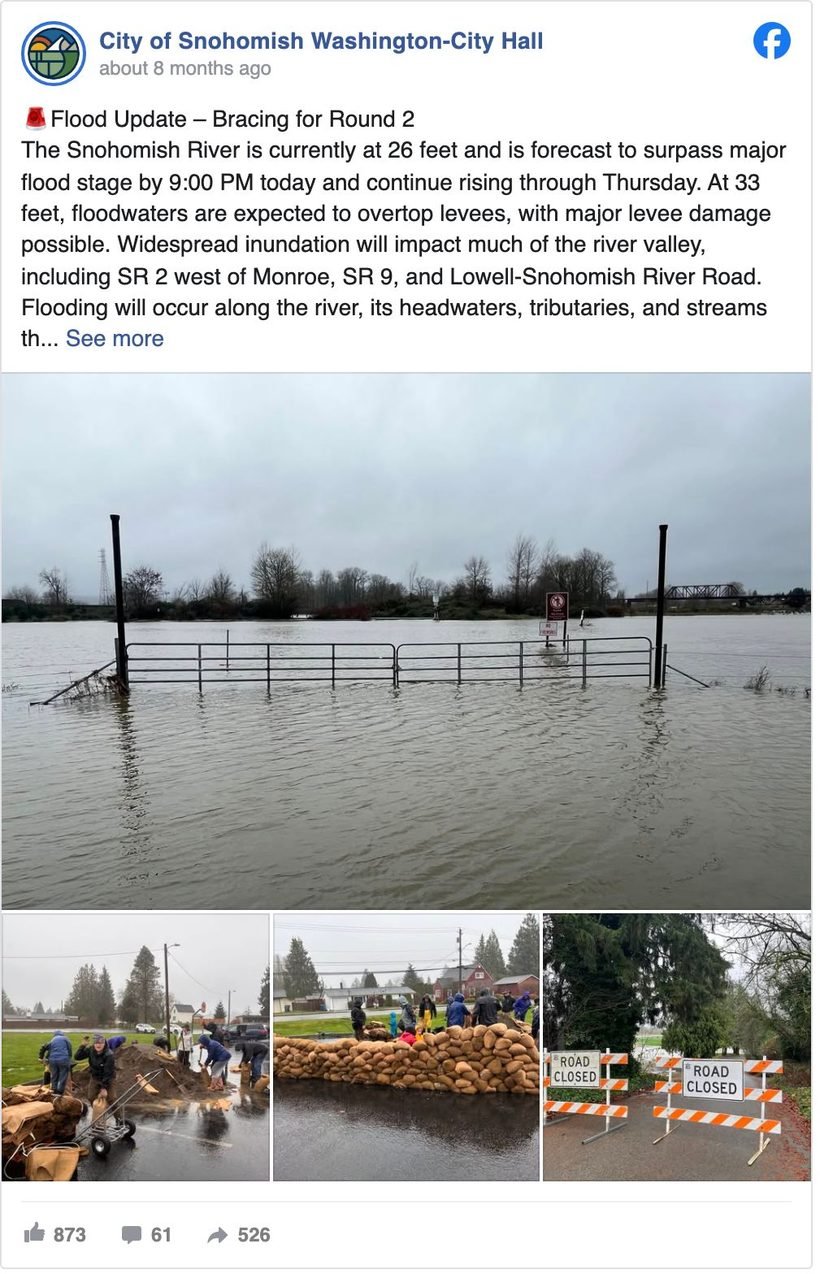
A flood update with photographs of the actual water, running to about 1,700 characters, carrying a link. The photos are why people stopped; the writing is why they read it; the link is where the road-closure detail lives. All three jobs, one post.
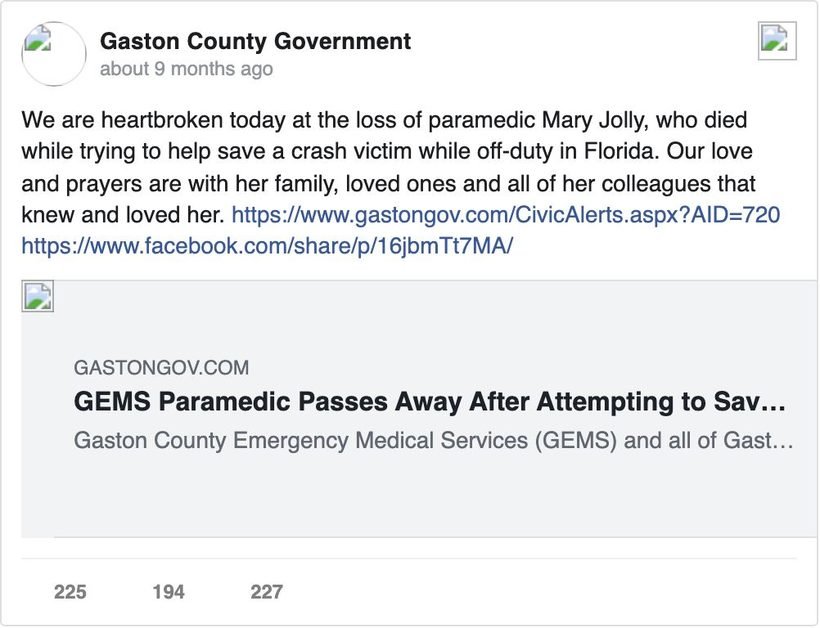
The death of a paramedic who was killed trying to help a crash victim while off duty. Two links, to the county’s own site. Likes, comments and shares almost exactly equal — an unusual signature, and what it looks like when a community responds to news rather than consuming a notice.
Six of the seven are emergencies, health notices or public-service information — which is the point rather than a selection artifact. The posts governments attach links to are disproportionately the posts residents most need to pass along, and passing along is the one behavior a link does not suppress.
What to do Monday
- Keep the link. If residents need to reach something, linking is how they reach it. A 25% haircut on likes is a rounding error against a resident who could not find the shelter address.
- Move it to the end. This is the single cheapest fix in this report — 0.82× versus 0.50×, for a change that takes ten seconds.
- One link per post. If you have four destinations, link the one page that holds the other three.
- Write the post so it stands alone. Length is the strongest lever here: a resident who never clicks should still learn the thing. That post is also the one that gets shared.
- Give it something to look at. A video carrying a link lands at 0.96×. A photo is worth having. Text plus a bare URL is the worst combination in the dataset at 0.54×.
- Change what you report to your manager. If you judge link posts on likes, you will conclude that linking fails, and you will stop doing the thing residents need. Report shares and reach on those posts, and put a UTM on the link so you can see the clicks that we cannot.
How we measured this
Frequently asked questions
Does adding a link reduce engagement on a Facebook post?
Yes, but less than commonly believed, and unevenly. Across 1.1 million local-government posts, a post with a link earns a median 0.75× what the same page’s link-free posts earn. Almost all of that falls on likes, which run 0.67×. Shares run 1.00× — no penalty at all. And 39.4% of link posts beat their own page’s normal post anyway.
Where should you put a link in a Facebook post?
At the end. Link posts with the URL in the final stretch run 0.82× their page’s norm, versus 0.50× when the link appears in the opening lines — a 64% difference driven by placement alone. Use one link rather than several: one link runs 0.78×, two 0.60×, three or more 0.57×.
Should local governments avoid posting links on Facebook?
No. 97% of governments link out and the typical one does it in about a quarter of its posts, because most civic tasks — finding a shelter, reading a notice, applying for a program — cannot fit in a post. The measured cost falls on likes, not on sharing, so the link does not impede the way civic information actually travels. The better move is to keep the link and control what surrounds it: put it last, use one, and write enough context that a resident who never clicks still understands the thing.
Do longer Facebook posts perform better for local government?
Yes, and it is the strongest lever we found. Link posts rise steadily with length: 0.50× under 160 characters, 0.75× at 400–800, and 1.07× above 1,500 characters. Link-free posts also improve with length and stay ahead at every band, so length does not eliminate the link penalty — but a long post carrying a link (1.07×) still outperforms a short post carrying none (0.80×).
See how peers write the posts that carry links.
Search what 5,000+ city and county governments post — by keyword, state, and population band.
“An exceptional way for people to look for ideas and comparisons.”