How to post about e-bikes and scooters
E-bikes and scooters are the rare local-government topic that’s contentious and genuinely confusing — residents don’t agree on where the things belong, and half of them aren’t sure what the rules even are. That combination is why these posts travel. Here is how local governments are handling it, and why the most-shared ones are the ones that clear up the confusion rather than lay down the law.
First: the top emotion here is confusion, not outrage
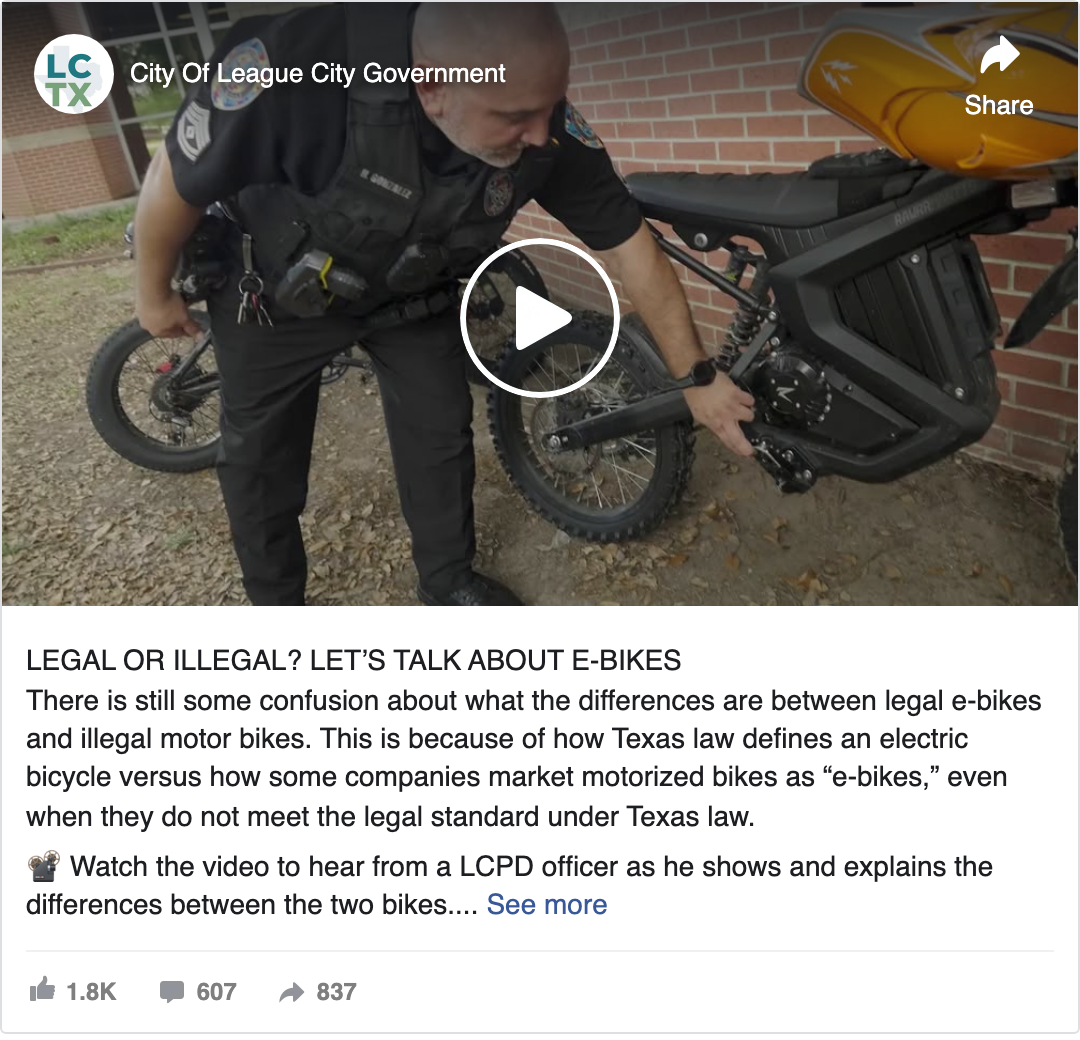
Unlike a surveillance-camera fight, most of the e-bike conversation isn’t anger — it’s genuine uncertainty. Different devices carry different rules (a Class 1 e-bike, a moped, and a standing scooter are not the same thing legally), the rules differ by street and path, and they’ve often changed recently. The most-shared post in this topic we found simply asked “LEGAL OR ILLEGAL? Let’s talk about e-bikes” and walked through the differences. Meeting the confusion head-on outperforms both the celebratory “new bike lane!” post and the stern “these are prohibited” post.
The postures local governments are taking — and how they frame each
- Clarifying the rules. The workhorse and the winner: a plain-language explainer of what’s allowed where, broken out by device type. “Different devices have different rules — here’s where yours is allowed” is the framing that gets forwarded, because it answers a question people are actively asking.
- Building for them. Governments announcing infrastructure — a skate/all-wheels park, protected lanes, parking corrals — do well when they frame it as “we heard you and here’s what we’re doing,” not just a ribbon-cutting.
- Safety and enforcement. These are necessary but land best when they lead with safety and specifics (helmet, lights, which paths) rather than punishment. A pure “you will be cited” post gets low engagement and high resentment; the same information framed as “how to ride legally and safely here” travels.
What makes these posts work
- Break it down by device type. Class 1/2/3 e-bikes, mopeds, standing scooters — residents genuinely don’t know the distinctions, and a simple breakdown is the whole value.
- Be specific about WHERE. Sidewalks vs. streets vs. multi-use paths vs. the downtown core. “Allowed” and “prohibited” mean nothing without the map.
- Lead with safety, not citations. The same rule lands very differently as “here’s how to ride safely” than as a threat.
- Say if the rules changed. A lot of the confusion is that the ordinance is new. “As of this month” tells people why their old assumption is wrong.
- Link to the ordinance and a map. Forwarded posts reach people who want the actual rule; give them the primary source and a where-allowed map if you have one.
A checklist you can paste into a draft
- What device types this applies to (and how they differ).
- Where each is allowed — sidewalks, streets, paths, downtown — specifically.
- The safety basics (helmet, lights, speed, age if applicable).
- Whether the rules recently changed, and when.
- A link to the ordinance and a where-allowed map.
- Frame it as helping people ride right, not a warning.
Want to see the explainer posts that actually cleared up the confusion in other towns? GovFeeds lets you search real local-government posts on e-bikes, scooters, and any other topic, filter to local governments your size and state, and see what earned engagement. Get a free benchmark for your community or take the 2-minute tour.