Government Communication Builds Trust — When It’s Done Well
If you run communications for a local government, you have probably wondered whether any of it truly moves the needle, or whether the posts and the notices just vanish into the feed. Two decades of peer-reviewed research in public administration has an answer, and it is more interesting than a flat yes. How a local government communicates with residents — through its website, its social media, its direct contact — is measurably tied to how much they trust it, how satisfied they are, and how much they support what it does. But the payoff shows up only when the work is done well, and done badly it can run the other way. Which means the research is really a story about your craft. (It also makes a sturdy case you can hand to a manager or council, which we come back to near the end.)
- Residents who use their local government’s website and social media report more trust in that government — a relationship established across national surveys and replicated for two decades (Tolbert & Mossberger 2006; Welch et al. 2005).
- The pathway is consistent: good communication makes a government feel transparent and responsive, and that perception is what drives trust and satisfaction (Kim & Lee 2012; Song & Lee 2016).
- The dividend is real but conditional. Information dumped out poorly can lower trust; the same openness delivered well raises it (Grimmelikhuijsen & Meijer 2014; Porumbescu 2016). A 2025 meta-analysis of 54 studies confirms a positive but modest effect that depends on how it is done (Li, Wang & Qu 2025).
- That conditionality is the argument for the profession: an autoposter cannot do this. The framing, timing, responsiveness, and judgment are the job, and they are the variable that decides whether transparency becomes trust.
- As trust in local news has fallen (82% in 2016 to 70% in 2025, Pew Research Center), the government’s own channels are increasingly residents’ primary source of civic information — which raises the stakes on doing them well.
In this brief: Why this matters now · Communication is tied to trust · And to satisfaction with services · Why the craft is the whole point · What it means for your work · How GovFeeds helps · References
Why this matters now
Two things have changed the job. First, residents have moved their civic attention onto the same feeds where they follow everything else, and local governments have followed them there: national practitioner surveys find social media use is now near-universal in local agencies. Second, the traditional filter between a government and its public — the local newsroom — has thinned. Trust in information from local news organizations fell from 82% in 2016 to 70% in 2025 (Pew Research Center), and the reporters who once explained a budget or a road project to the public are, in many communities, simply gone.
Put those together and the communications office is no longer a supplement to how residents learn about their government. It is increasingly the primary channel. That is a bigger job than it was ten years ago, and the research below is about what a government gets when it invests in doing it well.
Communication is tied to trust
The foundational study is Caroline Tolbert and Karen Mossberger’s 2006 article in Public Administration Review — later named one of the 75 most influential articles in that journal’s history. Analyzing national survey data, they found a statistically significant relationship between trust in government and use of a local government website, and argued that digital government builds “process-based” trust: residents come to see government as more responsive and capable when they can interact with it directly and actually get what they came for.
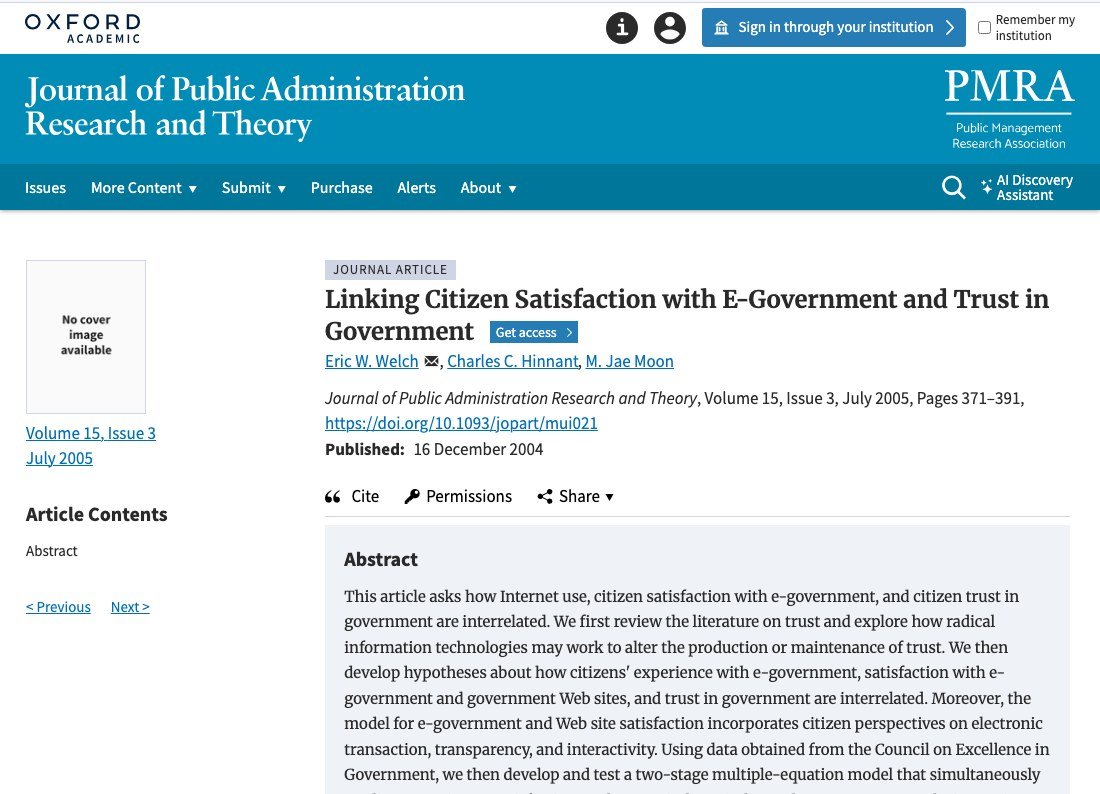
It was not a one-dataset fluke. Eric Welch, Charles Hinnant, and M. Jae Moon showed in the Journal of Public Administration Research and Theory (2005) that citizens’ experience with e-government, their satisfaction with government websites, and their trust in government are interrelated: people who have good online experiences report more satisfaction, and that satisfaction is linked to trust. The website is not a place to download a form. It is a touchpoint where a relationship is strengthened or eroded.
And to satisfaction with services
Satisfaction has a well-tested mechanism behind it. Gregg Van Ryzin’s expectancy-disconfirmation work (JPART, 2006) shows that residents judge services by the gap between what they expected and what they perceive they received. Communication sits on both sides of that gap: it sets expectations honestly, and it shapes whether residents even notice the plowed road, the answered permit, the resolved complaint. A service delivered silently and a service delivered with a clear, timely word to the public are not the same service in a resident’s memory.
The digital channels feed the same loop. Soonhee Kim and Jooho Lee (Public Administration Review, 2012) found that residents who were satisfied with a city’s online participation tools rated the city as more transparent, and that transparency was in turn tied to trust in the local government. Changsoo Song and Jooho Lee (Public Performance & Management Review, 2016) found the same chain running through social media: use of a government’s accounts raised perceived transparency, which raised trust.
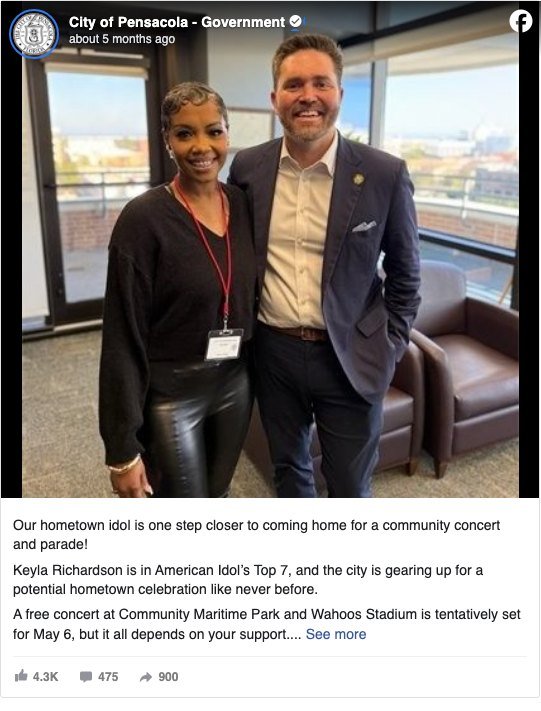
From our own corpus of local-government posts: Pensacola, Florida rallying residents around a hometown American Idol contestant and a planned community concert. It is not an announcement — it is a government sharing something residents already care about. 4,300 reactions and 900 shares: the human, community-facing register the research ties to satisfaction and trust.
Why the craft is the whole point
Here is the part that matters most for a budget conversation, and it is the part a lazy version of this brief would skip. The research does not say that a website or a Facebook page automatically produces trust. It says the opposite is possible.
Stephan Grimmelikhuijsen and colleagues, in experiments published in Public Administration Review (2013) and the Journal of Public Administration Research and Theory (2014), showed that simply making information available does not reliably raise trust — depending on how it is framed and who receives it, transparency can have a muted effect or even a negative one. Gregory Porumbescu (Public Management Review, 2016) found something sharper still: in a study of 1,100 Seoul residents, heavier use of dense, information-heavy government websites was associated with lower satisfaction and trust, while use of the leaner, more human register of government social media was associated with higher satisfaction and trust. And a 2025 meta-analysis synthesizing 143 findings from 54 studies (Li, Wang & Qu, Public Management Review) put a number on the whole literature: transparency’s effect on citizen satisfaction is positive but modest, and heavily moderated by how it is defined and delivered.
Read cynically, “it depends” sounds like a caveat. Read correctly, it is the entire case for the profession. If dumping raw information on the public reliably built trust, no one would need a communications team — a data portal and an autoposter would do it. The reason communicators are worth funding is precisely that the effect is conditional. Whether a budget document reassures or alarms, whether a service alert calms a rumor or feeds it, whether a reply de-escalates or inflames, depends on framing, timing, tone, responsiveness, and judgment. Those are the daily decisions of a government communicator, and the research is telling us they are the variable that turns transparency into trust.
What it means for your work
Read as practice rather than theory, the studies point to a handful of things a communicator can actually do differently on Monday — and each one is a small trust decision the research says pays off.
- Answer, don’t just announce. Trust is “process-based” — it grows when residents experience government as responsive (Tolbert & Mossberger 2006). Every reply and returned message is doing more work than it looks like.
- Match the message to the channel. The lean, human register of social media can build trust that a dense web portal does not (Porumbescu 2016). Cross-posting the same wall of text everywhere leaves that on the table.
- Set honest expectations. Satisfaction is the gap between what residents expected and what they perceive they got (Van Ryzin 2006). Over-promising can cost you even when the service is fine; a plain heads-up can win you credit for work you were already doing.
- Frame openness, don’t just publish it. Raw information released without care can leave trust flat or lower it (Grimmelikhuijsen & Meijer 2014). The framing is not busywork; it is the part that turns transparency into trust.
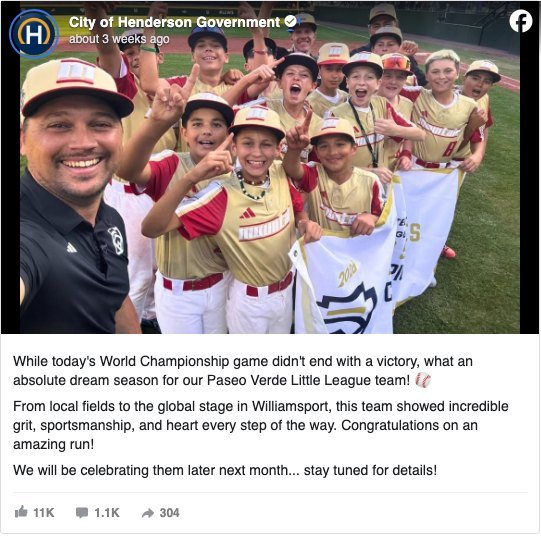
Also from our corpus: Henderson, Nevada congratulating its Little League team on “an absolute dream season.” No portal, no form — a government talking like a neighbor, in the lean, human register that Porumbescu (2016) found associated with higher trust. 11,000 reactions.
The through-line is that none of this is automatic, and all of it is judgment — the daily calls that separate communication that builds trust from communication that erodes it. That is worth knowing for its own sake. It is also, when you need it, the argument to take upstairs.
If you need to make the case to leadership
Because every claim here traces to a peer-reviewed study, this brief doubles as evidence for a hire, a tool, or protected time. In budget terms, communication done well buys trust you can measure, higher satisfaction at the same service level (satisfaction runs on expectations, not just outcomes), and a hedge against misinformation now that local news is thinner — a return that scales with skill, not spend. Keep the honest caveat in the memo: the payoff comes from doing the work well, which is precisely the case for investing in the people and the tools, not just the channels.
How GovFeeds helps your team do this
Everything above points to the same practical need: communicate responsively, learn what works, and be able to show your leadership that it is working. That is what GovFeeds is built for. It indexes what more than 5,000 city and county governments actually post, so a communicator can answer the three questions this research raises — what should we say, how are peers handling this, and how do we prove it to the council?
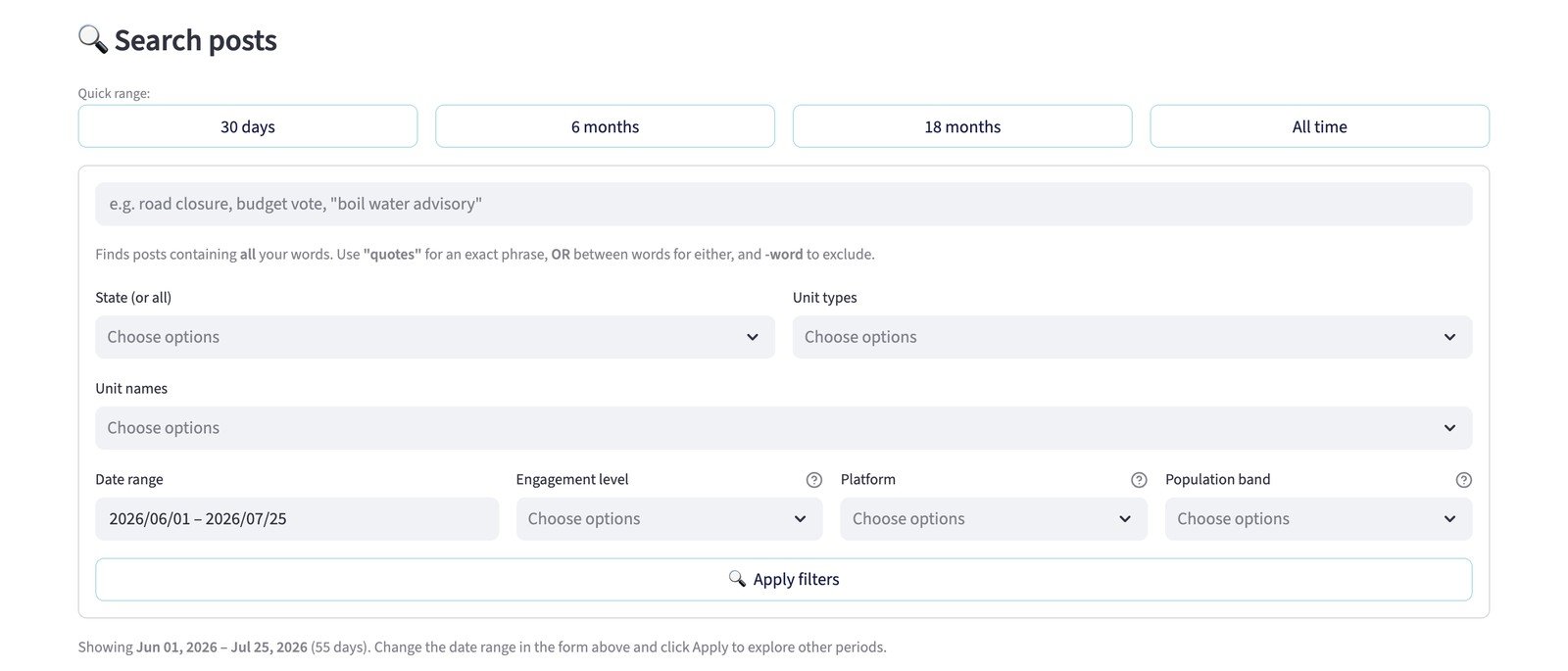
Search any topic and see how peer governments — filtered to your state, size, and platform — actually communicated it, ranked by how residents engaged. It turns “do it well” from advice into examples you can borrow.
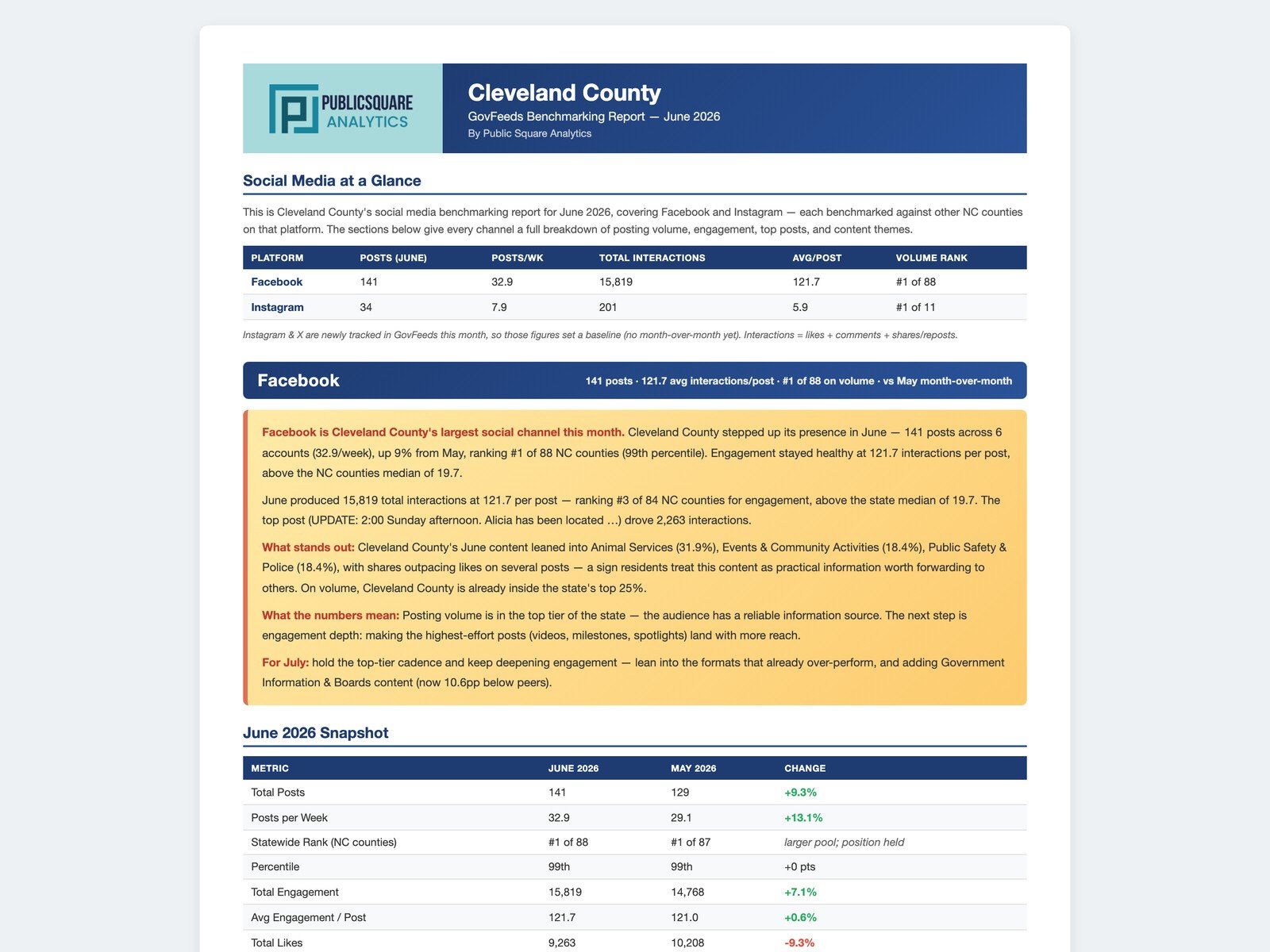
The same brief you are reading argues that communications is worth funding; GovFeeds gives you the benchmark report to prove your team is delivering it — your engagement against comparable governments, in a format built to hand to a manager or council.
References
Every source below is a peer-reviewed study; links go to the publisher of record.
- Tolbert, C. J., & Mossberger, K. (2006). The Effects of E-Government on Trust and Confidence in Government. Public Administration Review, 66(3), 354–369. doi:10.1111/j.1540-6210.2006.00594.x
- Welch, E. W., Hinnant, C. C., & Moon, M. J. (2005). Linking Citizen Satisfaction with E-Government and Trust in Government. Journal of Public Administration Research and Theory, 15(3), 371–391. doi:10.1093/jopart/mui021
- Van Ryzin, G. G. (2006). Testing the Expectancy Disconfirmation Model of Citizen Satisfaction with Local Government. Journal of Public Administration Research and Theory, 16(4), 599–611. doi:10.1093/jopart/mui058
- Kim, S., & Lee, J. (2012). E-Participation, Transparency, and Trust in Local Government. Public Administration Review, 72(6), 819–828. doi:10.1111/j.1540-6210.2012.02593.x
- Mossberger, K., Wu, Y., & Crawford, J. (2013). Connecting citizens and local governments? Social media and interactivity in major U.S. cities. Government Information Quarterly, 30(4), 351–358. doi:10.1016/j.giq.2013.05.016
- Grimmelikhuijsen, S., Porumbescu, G., Hong, B., & Im, T. (2013). The Effect of Transparency on Trust in Government: A Cross-National Comparative Experiment. Public Administration Review, 73(4), 575–586. doi:10.1111/puar.12047
- Grimmelikhuijsen, S., & Meijer, A. J. (2014). Effects of Transparency on the Perceived Trustworthiness of a Government Organization: Evidence from an Online Experiment. Journal of Public Administration Research and Theory, 24(1), 137–157. doi:10.1093/jopart/mus048
- Song, C., & Lee, J. (2016). Citizens’ Use of Social Media in Government, Perceived Transparency, and Trust in Government. Public Performance & Management Review, 39(2), 430–453. doi:10.1080/15309576.2015.1108798
- Porumbescu, G. A. (2016). Comparing the Effects of E-Government and Social Media Use on Trust in Government: Evidence from Seoul, South Korea. Public Management Review, 18(9), 1308–1334. doi:10.1080/14719037.2015.1100751
- Li, R., Wang, Q., & Qu, T. (2025). Transparency and citizen satisfaction: a meta-analysis and future research agenda. Public Management Review (published online). doi:10.1080/14719037.2025.2456658
Framing statistic on local-news trust: Pew Research Center (2025), How Americans’ trust in information from news organizations and social media has changed over time. This brief synthesizes published research for a practitioner audience; it is not itself a peer-reviewed study.
Frequently asked questions
Does government communication actually increase trust, or is that just a nice idea?
It is an empirical finding, replicated for two decades. National-survey research (Tolbert & Mossberger 2006; Welch et al. 2005) links residents’ use of a local government’s website to higher trust in that government, and later work traces the pathway through perceived transparency and responsiveness for both e-participation (Kim & Lee 2012) and social media (Song & Lee 2016). The important nuance: the effect is real but conditional on the communication being done well, which is the case for investing in skilled communicators rather than just channels.
Can I hand this to my city manager or council to argue for our communications budget?
Yes — that is what this brief is for. The “Taking this to your manager or council” section translates the research into budget terms: trust you can measure, higher satisfaction at the same service level, a hedge against misinformation, and a return that scales with skill rather than spend. Every claim is sourced to a peer-reviewed study in the reference list, so it stands up to scrutiny.
Doesn’t more transparency automatically mean more trust?
No, and it is important to be honest about that. Experiments (Grimmelikhuijsen & Meijer 2014; Grimmelikhuijsen et al. 2013) show that information released without care can leave trust unchanged or even lower it, and a 2025 meta-analysis of 54 studies (Li, Wang & Qu) finds the average effect positive but modest and heavily dependent on how transparency is delivered. That conditionality is the argument for the profession: framing, timing, and responsiveness are what turn openness into trust, and those are a communicator’s craft.
Which matters more, our website or our social media?
Both matter, but the research suggests they work differently. A study of Seoul residents (Porumbescu 2016) found the leaner, more human register of government social media associated with higher trust and satisfaction, while heavy use of dense, information-dump websites was associated with lower trust. The lesson is not to abandon the website but to match the message to the channel and keep the human voice — a judgment call communicators make daily.
See what earns trust in communities like yours.
GovFeeds benchmarks your social media against 5,000+ peer governments — so you can learn what works, sharpen your own posts, and, when you need it, show your leadership the results.
“An exceptional way for people to look for ideas and comparisons.”