How Local Governments Are Talking About AI on Facebook
We read nearly a million local-government Facebook posts to find every place a city or county talked about artificial intelligence — AI policy, hearings, scam warnings, chatbots, and more. We found 957 posts from 570 governments across 49 states. Here’s what local government is actually saying about AI — theme by theme, with real examples you can borrow.
Two years ago, “AI” barely appeared in a city’s feed. Today it’s everywhere — and not in one register but many. The same dataset that holds a township’s AI ordinance also holds a sheriff’s deepfake warning, a library’s “AI 101” flyer, a county’s new chatbot, and a public-works crew rendered as AI caricatures. Sorted out, the 957 posts fall into seven clear themes.
The seven themes, by volume:
- Teaching residents about AI — workshops, library classes, AI summits (the single largest group)
- Government AI deployment — chatbots, AI on the 911 line, traffic and inspection tools
- Public-safety warnings — AI scams, voice cloning, deepfakes, misinformation
- Policy & governance — AI-use ordinances, acceptable-use standards, task forces
- AI data centers — hearings, moratoria, zoning, and rumor control
- Economy & workforce — recruiting AI firms, innovation hubs, jobs
- The lighter side — AI caricatures and holiday images, just for fun
We’ll take them roughly in order of how consequential they are for a communications team — starting with the governments writing the rules.
1. Writing the rulebook: AI policies, ordinances & task forces
The most consequential AI posts come from governments that have moved from talking to governing. Cities and counties are adopting formal acceptable-use policies, standing up AI task forces, and passing ordinances that decide how — and whether — AI gets used in the public’s name. These are small governments doing serious institutional work, often years ahead of their state.
| Government | Date | What they posted | |
|---|---|---|---|
| Hobart, WI | Apr 2026 | Village Board advances Policy 2026-04, a formal “Use of Artificial Intelligence (AI) Policy” setting procedures and guidelines for AI systems used by the Village. | View ↗ |
| Galena, MD | Jun 2026 | Mayor & Council adopt an ordinance establishing a policy governing the Town’s use of artificial intelligence. | View ↗ |
| Little Rock, AR | Apr 2026 | City adopts a new AI policy for city government. | View ↗ |
| Cobb County, GA | May 2026 | Earns a state Best Practices award for its “Artificial Intelligence Acceptable Use Standards.” | View ↗ |
| Greenwich, CT | Apr 2026 | First Selectman announces the formation of a Town of Greenwich AI Task Force. | View ↗ |
| New Shoreham (Block Island), RI | May 2025 | Shares the Rhode Island AI Task Force’s statewide public-input survey. | View ↗ |
| Pinole, CA | May 2026 | City announces it is developing an Artificial Intelligence (AI) Policy. | View ↗ |
| Lebanon, NH | May 2026 | City’s Chief Innovation & AI Officer earns a national honor for leading responsible AI use. | View ↗ |
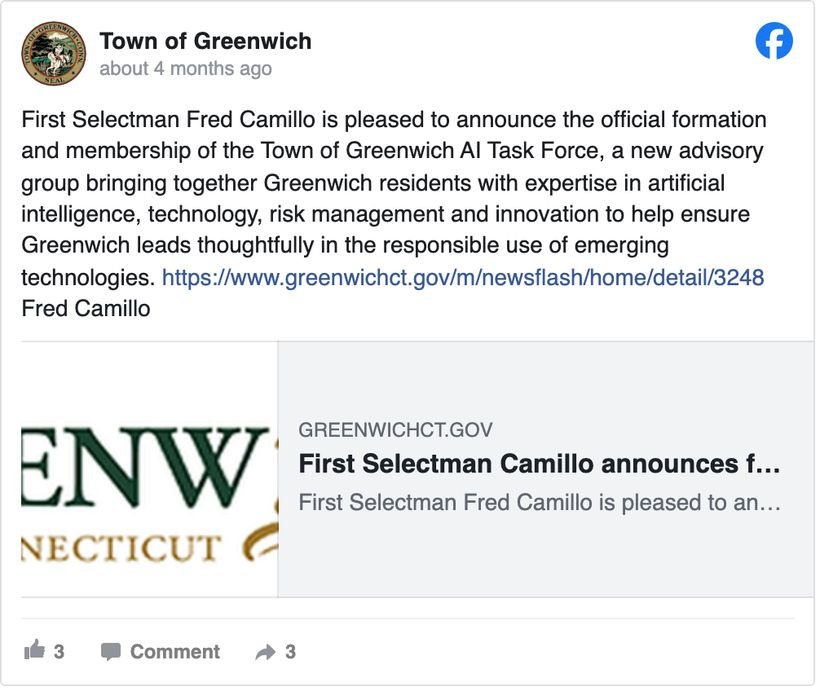
Rather than announce a finished rule, Greenwich announced the people: an advisory group of residents with expertise in AI, technology, risk management and innovation. Naming who is in the room is the move most of these rulebook posts skip — and it is the one that invites residents to trust the process that follows.
2. The data-center reckoning
No AI topic is more charged at the local level than the data centers that power it. As hyperscale “AI data centers” chase cheap land and power, residents are showing up to meetings — and communicators are responding with public hearings, moratoria, zoning fights, and rapid rumor control. The same week one city breaks ground on an “AI Factory,” another votes to keep them out entirely.
| Government | Date | What they posted | |
|---|---|---|---|
| Pocatello, ID | May 2026 | 300+ residents pack a public hearing on a conditional-use permit for an Artificial Intelligence Data Center. | View ↗ |
| Orange County, NC | Apr 2026 | Board holds a public hearing on a one-year moratorium ordinance on data centers as a land use. | View ↗ |
| Jackson County, FL | May 2026 | Board votes unanimously to advance a one-year moratorium on AI data-center development. | View ↗ |
| New Albany, IN | Jun 2026 | Mayor asks the Common Council for a moratorium on new data-center development. | View ↗ |
| Cranford, NJ | May 2026 | Township committee announces its stance not to permit AI data centers in Cranford. | View ↗ |
| Decatur, AL | Jun 2026 | “Internet rumor control”: city debunks a rumored Meta AI Data Center on Country Club Road. | View ↗ |
| Hammonton, NJ | May 2026 | Town Council schedules a public meeting to help residents “separate fact from fiction” on a proposed AI data center. | View ↗ |
| Independence, MO | May 2026 | City breaks ground on Nebius’s “AI Factory” data-center campus. | View ↗ |
| Piqua, OH | Jun 2026 | City Commission approves an AI / data-center campus and posts a resident resource page. | View ↗ |
| Lancaster, PA | Nov 2025 | City hosts a community open house on a proposed AI Hub data center. | View ↗ |
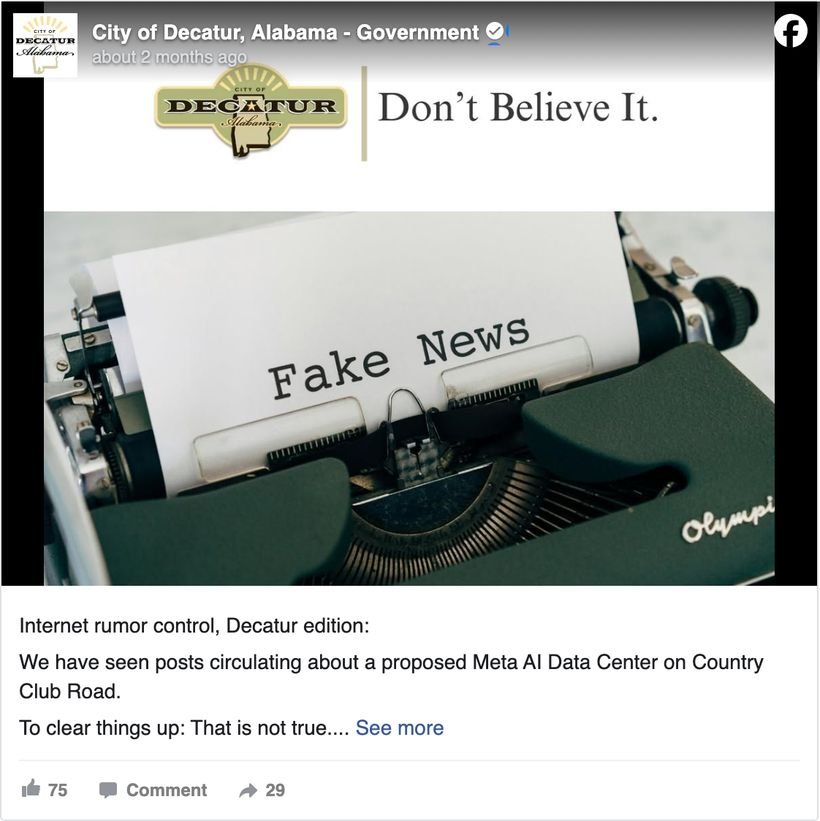
A branded “Don’t Believe It” template, deployed against a rumored Meta AI data center on Country Club Road: “To clear things up: That is not true.” The reusable graphic is the interesting part — Decatur built a rumor-response format it can run again next month, instead of writing each correction from scratch.
3. AI on the front line of public safety
For most communicators, the first time AI showed up in their feed wasn’t a policy debate — it was a threat. Voice-cloning scams, deepfake videos of mayors, AI-generated fake invoices and fake emergency images are spreading faster than the truth. Local governments have become the trusted debunker, and a remarkably consistent playbook has emerged: name the tactic, show the tell, and give people one concrete thing to do.
| Government | Date | What they posted | |
|---|---|---|---|
| Grand Island, NE | Nov 2025 | Debunks an AI deepfake video showing the mayor “banning Christmas lights.” | View ↗ |
| Union County, OR | May 2026 | Warns that AI can clone a loved one’s voice to call and ask for money. | View ↗ |
| Keene, NH | Jun 2026 | Police advise residents about scams using generative AI — synthesized voices and impersonation; set a family “safe word.” | View ↗ |
| Atlantic County, NJ | Apr 2026 | Sheriff alerts residents to AI-powered impersonation scam calls. | View ↗ |
| Medina County, OH | Feb 2026 | Scam alert: scammers using an AI-generated voice to spoof calls. | View ↗ |
| Port St. Lucie, FL | Apr 2026 | Warns scammers are using AI to craft convincing emails, letters and phone calls. | View ↗ |
| Whatcom County, WA | Apr 2026 | Alert: scammers using AI to generate fake county invoices. | View ↗ |
| Terrebonne Parish, LA | Dec 2025 | Debunks an AI-generated image of “government towers on fire.” | View ↗ |
| Port Chester, NY | Jan 2026 | Corrects a viral AI-created image falsely showing the village Christmas tree fallen over. | View ↗ |
| Baldwin Borough, PA | Mar 2026 | Library hosts “Spot the Bot,” a class on voice cloning and telling real audio from AI-generated. | View ↗ |

An AI deepfake circulated showing Mayor Steele banning Christmas lights. The city’s answer led with the flat denial — “NO, Christmas lights are not banned” — over a photo of an extravagantly lit house. It drew 89 reactions and 30 shares, the forwarding pattern of a correction residents want their neighbors to see.
4. Putting AI to work inside city hall
Plenty of governments aren’t just talking about AI — they’re shipping it. Resident-facing chatbots are the most common, but the deployments run deeper: AI answering the non-emergency police line, optimizing traffic signals, reading recycling streams, and translating body-cam audio in real time. These posts are essentially product launches, and the best of them lead with the resident benefit, not the technology.
| Government | Date | What they posted | |
|---|---|---|---|
| Miami, FL | Jun 2026 | Launches a Code Compliance Chatbot with English, Spanish and Haitian-Creole support. | View ↗ |
| Raleigh, NC | Jan 2026 | Pilots AI to optimize traffic-signal timing and improve safety at intersections. | View ↗ |
| Scottsdale, AZ | May 2026 | Police prepare to roll out an AI-assisted non-emergency call system. | View ↗ |
| Frisco, TX | May 2026 | Police non-emergency line is now answered by an “AI Agent.” | View ↗ |
| Palo Alto, CA | Jan 2026 | Launches “CityAssist,” an AI pilot on the city website. | View ↗ |
| Decatur, AL | Mar 2026 | City Council approves new artificial-intelligence technology for the recycling facility. | View ↗ |
| Bozeman, MT | Apr 2026 | Pilots “Comcate Connect,” a voice AI agent for Neighborhood Services. | View ↗ |
| Pitt County, NC | Jul 2025 | Launches “Easton,” a 24/7 website chatbot. | View ↗ |
| Storm Lake, IA | Dec 2025 | Council approves AI-enabled police cameras with real-time translation. | View ↗ |
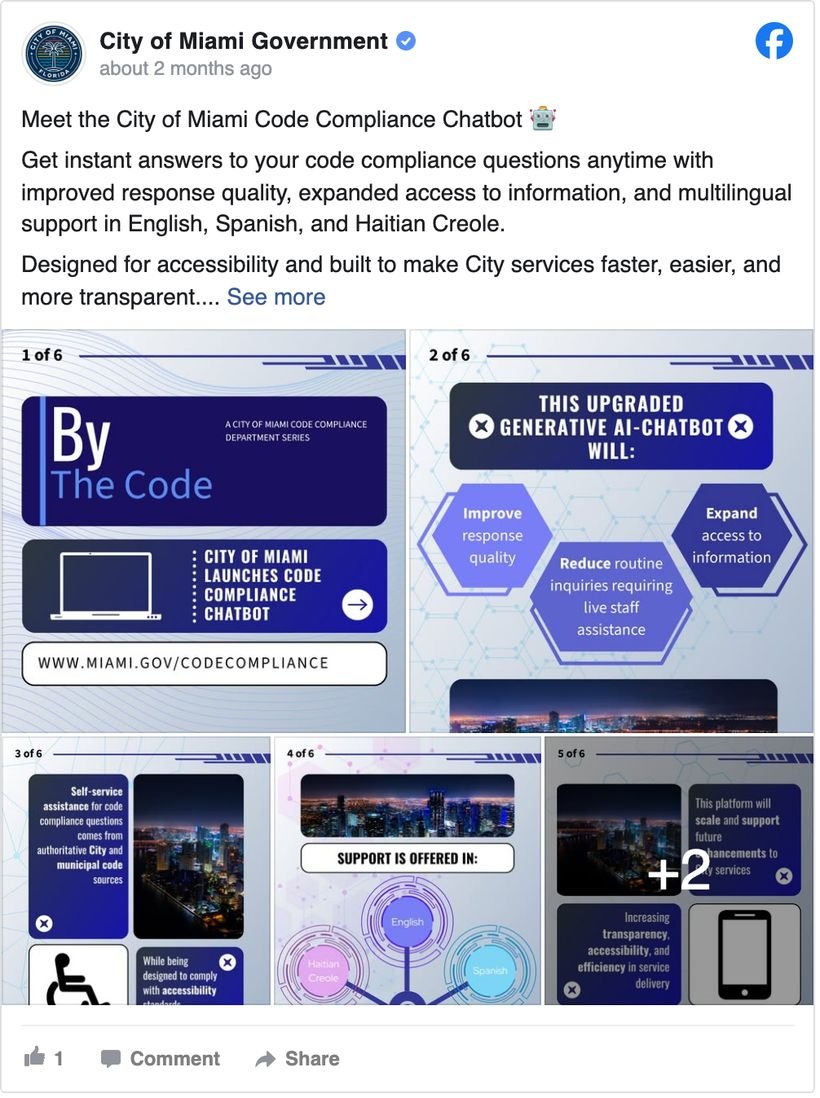
Miami’s Code Compliance Chatbot post is a six-card explainer: what the generative-AI chatbot will do, that support covers English, Spanish and Haitian Creole, that answers come from authoritative city and municipal code sources, and that it is built to accessibility standards. Naming the limits and the sources is what separates a service announcement from a press release.
5. Teaching the public about AI
A quieter but huge category: governments — usually through their libraries, senior centers, and economic-development offices — running AI literacy programs. Free workshops, “AI 101” classes, regional AI summits, and senior-focused sessions on spotting AI scams. It’s local government quietly taking on the job of helping residents understand a technology that arrived faster than anyone’s curriculum.
| Government | Date | What they posted | |
|---|---|---|---|
| Orange County, NY | Mar 2026 | “The Future of AI” convenes 500+ Hudson Valley leaders at Mount Saint Mary College. | View ↗ |
| Dutchess County, NY | Mar 2026 | Partners with Marist University to host the annual Hudson Valley AI Summit. | View ↗ |
| Secaucus, NJ | May 2026 | Public Library hosts “Unlock the Power of AI,” a beginner-friendly workshop. | View ↗ |
| Irwindale, CA | Feb 2026 | Public Library workshop on “Artificial Intelligence and its impact on our daily lives.” | View ↗ |
| District Heights, MD | Sep 2025 | Free “Tech Tuesdays” for residents 55+ include exploring the world of AI. | View ↗ |
| Greenfield, IN | Jun 2026 | Promotes a free “AI Essentials” workshop through Ivy Tech. | View ↗ |
| Sampson County, NC | May 2026 | “AI in Action: Tools for Manufacturing & Business,” a free hands-on course. | View ↗ |
| Hamilton County, OH | Jun 2026 | Clerk of Courts welcomes attendees to “Cincy AI Week.” | View ↗ |
| South Milwaukee, WI | Nov 2025 | Hosts an “AI & Business Ideation” workshop. | View ↗ |
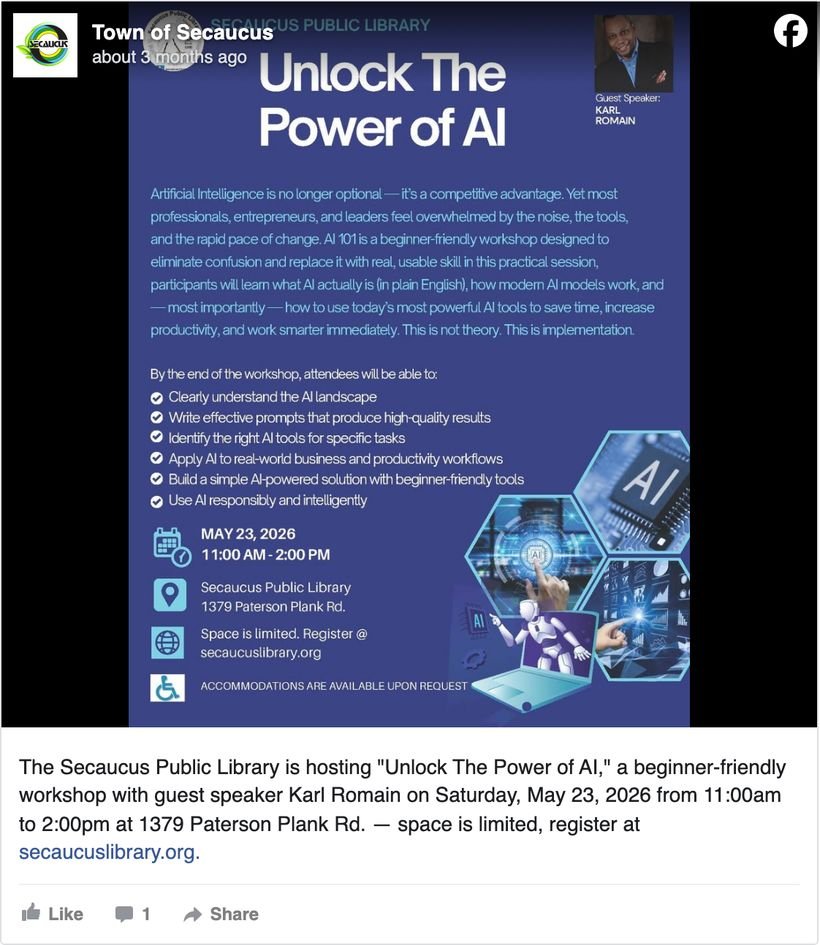
“Unlock the Power of AI” — a beginner-friendly workshop at the public library. This is the most common shape of AI education in our data: not the city’s IT department, but the library, running a free class for residents who want to understand the thing everyone is talking about.
6. AI and the local economy
Economic-development teams have folded AI squarely into the jobs conversation — recruiting AI companies, opening innovation hubs, launching AI/ML startup accelerators, and bracing the workforce for what’s coming. Here AI is framed less as a threat and more as the thing the town wants a piece of.
| Government | Date | What they posted | |
|---|---|---|---|
| Okaloosa County, FL | Jan 2026 | Ribbon-cutting for EpiSci / Applied Intuition, an AI and tactical-autonomy software firm. | View ↗ |
| Rancho Cordova, CA | May 2026 | Advances a workforce effort within the city’s “AI and Robotics Ecosystem.” | View ↗ |
| San Bernardino, CA | Feb 2026 | Opens a new “Kinetic AI Hub” at the BBOP Center. | View ↗ |
| Alexandria, VA | Jun 2026 | Opens applications for an accelerator serving startups in AI/ML. | View ↗ |
| Brownsville, TX | May 2026 | Hosts a Smart City Innovation Conference on how AI is transforming the region. | View ↗ |
| Elizabeth, NJ | May 2026 | Welcomes OSMO, an AI-powered “scent technology” company, to its first production site. | View ↗ |
| Cotati, CA | Nov 2025 | Hosts an “AI Small Business Day” with the Sonoma SBDC. | View ↗ |
| Niagara County, NY | Nov 2025 | Promotes trades training, citing an estimate that up to 100M U.S. jobs could be displaced by AI. | View ↗ |
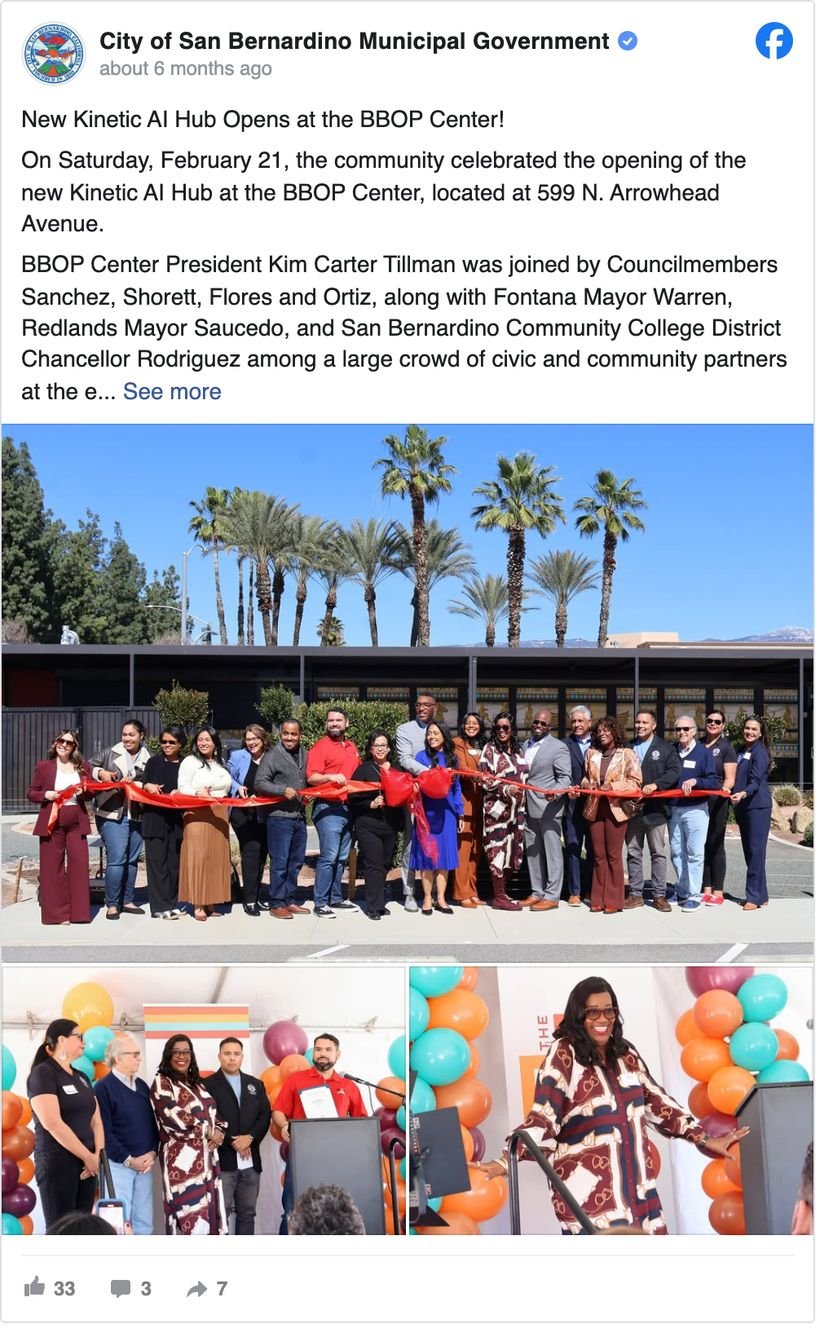
The new Kinetic AI Hub at the BBOP Center — AI framed not as a threat to jobs but as the thing the city is building capacity around. Economic-development posts in this theme run consistently positive, which is a notable contrast with the data-center theme two sections up: the same technology, opposite civic reception.
7. When city hall has a little fun with AI
Not every AI post is weighty. A whole genre is just local governments being charming with the new toy — AI caricatures of the public-works crew, AI holiday cards, playful image prompts. They’re low-stakes, but they humanize the institution and routinely out-engage the serious stuff. (The best ones, notably, label the image as AI — a small act of the same transparency the scam-warnings preach.)
| Government | Date | What they posted | |
|---|---|---|---|
| Whatcom County, WA | Apr 2026 | Annual April Fool’s post: an “AI holographic tour guide” for county parks — a talking Sasquatch. | View ↗ |
| Fountain, CO | May 2026 | “Dear Chatbot, create a town with snowy mountains…” — a playful AI-generated promo. | View ↗ |
| Winder, GA | Feb 2026 | Posts AI-created caricatures of every city department. | View ↗ |
| Inver Grove Heights, MN | Feb 2026 | Joins the “caricature craze” with AI portraits of staff. | View ↗ |
| Excelsior Springs, MO | Dec 2025 | Local fire & EMS agencies challenge each other to AI-generate department holiday images. | View ↗ |
| Lenoir, NC | Jan 2026 | Posts an AI image of an “AT-AT walker on ice” with a clear “this is AI” disclaimer on a winter-safety reminder. | View ↗ |
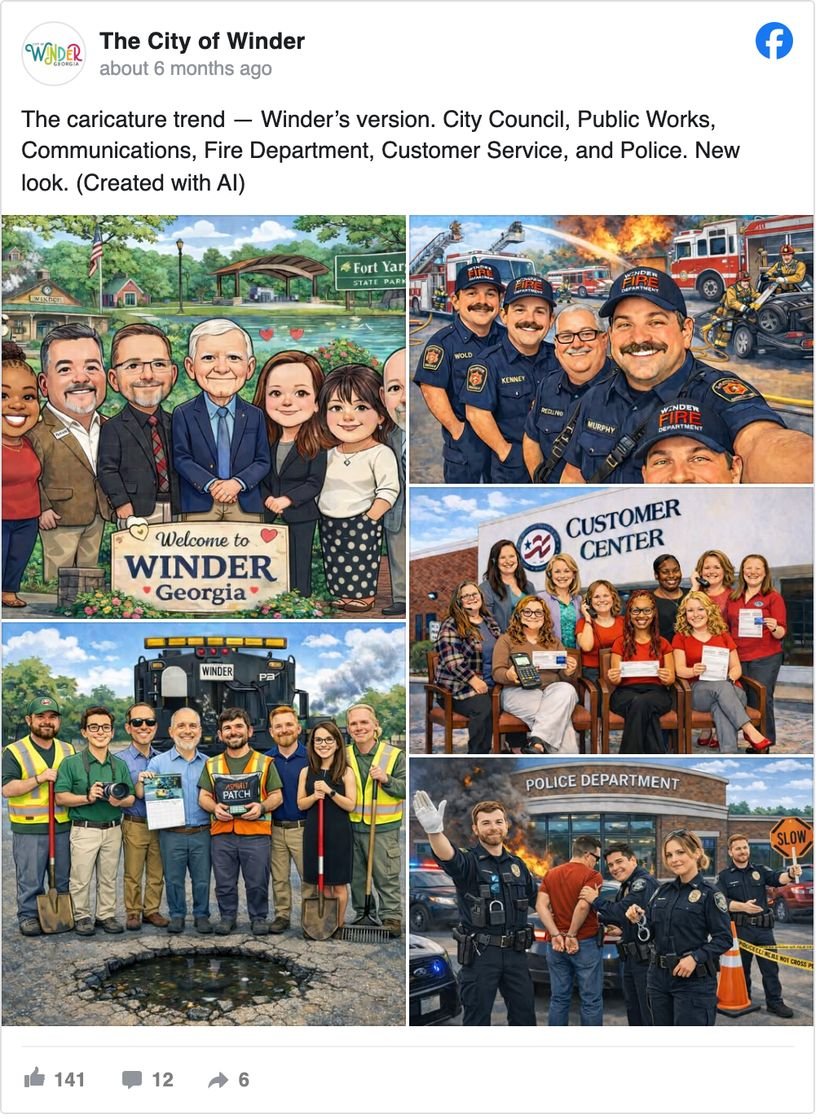
Six AI caricatures — council, public works, communications, fire, customer service, police — captioned plainly: “(Created with AI)”. 141 reactions on a page whose median post earns far less. The disclosure is doing real work here: it makes the images a joke the city is in on, rather than something residents have to figure out.
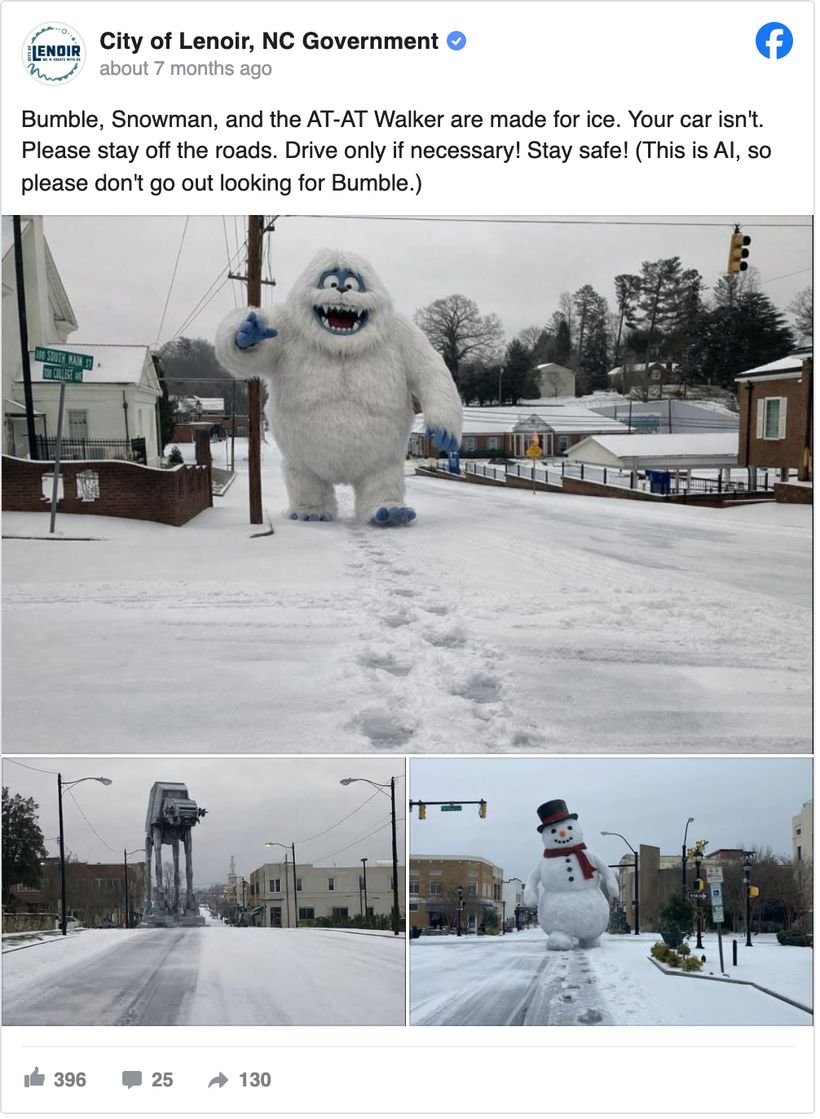
An AI image of an AT-AT walker sliding on ice, attached to a winter-safety reminder and carrying an explicit “this is AI” disclaimer. 396 reactions and 130 shares — the most-engaged AI-related post in this entire dataset. The lesson is not “use AI art”; it is that a genuinely funny image attached to a real safety message travels, and the disclosure costs nothing.
Governments need tools built for this work
Look back over those seven themes and one thing is clear: this is fast, high-stakes communication — explaining an AI data center to a packed hearing room, getting ahead of a deepfake before it spreads, announcing a policy the council passed on Monday. It’s a new job, and the tools most comms teams reach for weren’t built for it. The communicators we talk to keep telling us the same thing: conventional tools don’t have the context. A general-purpose AI chatbot has never read a single thing the town down the road posted; a marketing scheduler can’t tell a public hearing from a product launch. They hand you something fluent and confident, but disconnected from the only question that matters here — what actually works for governments like yours.
That’s the gap GovFeeds AI was built to close. It’s purpose-built for local-government social media and wired directly into the same corpus of 959,000+ posts from 5,000+ city and county accounts behind this report. Ask it for a draft, or for a read on what peers are doing, and every answer is grounded in real posts it retrieves and cites — never invented. Two unedited examples:
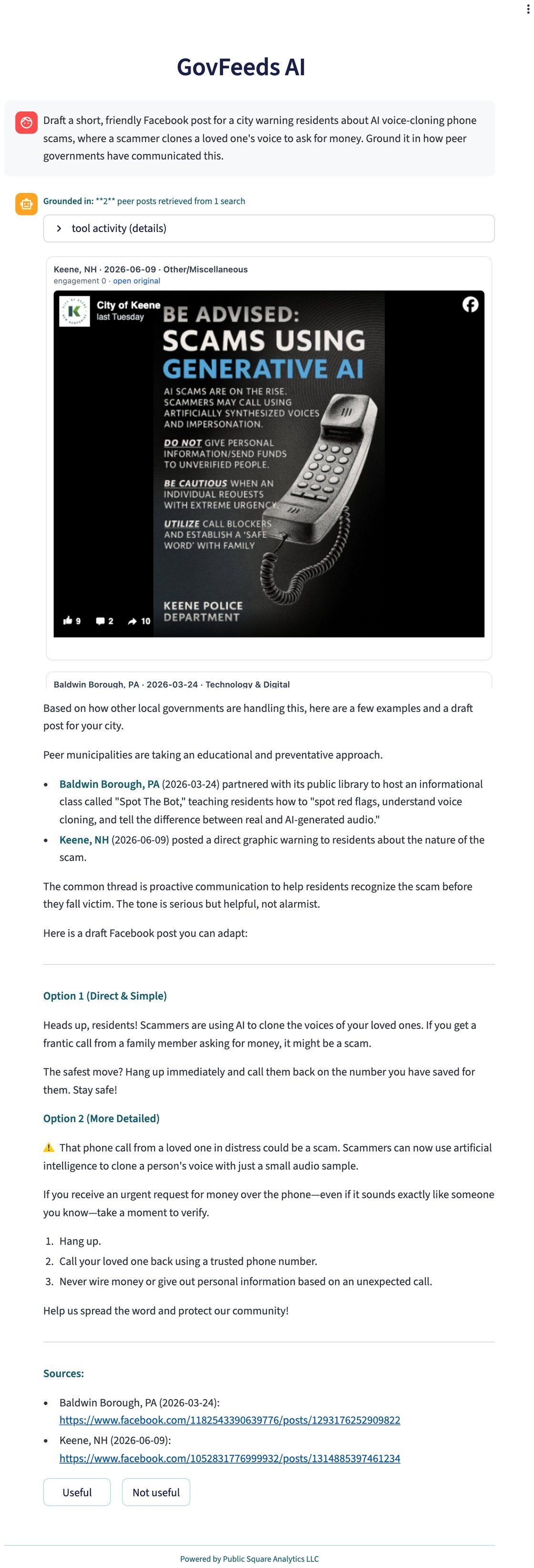
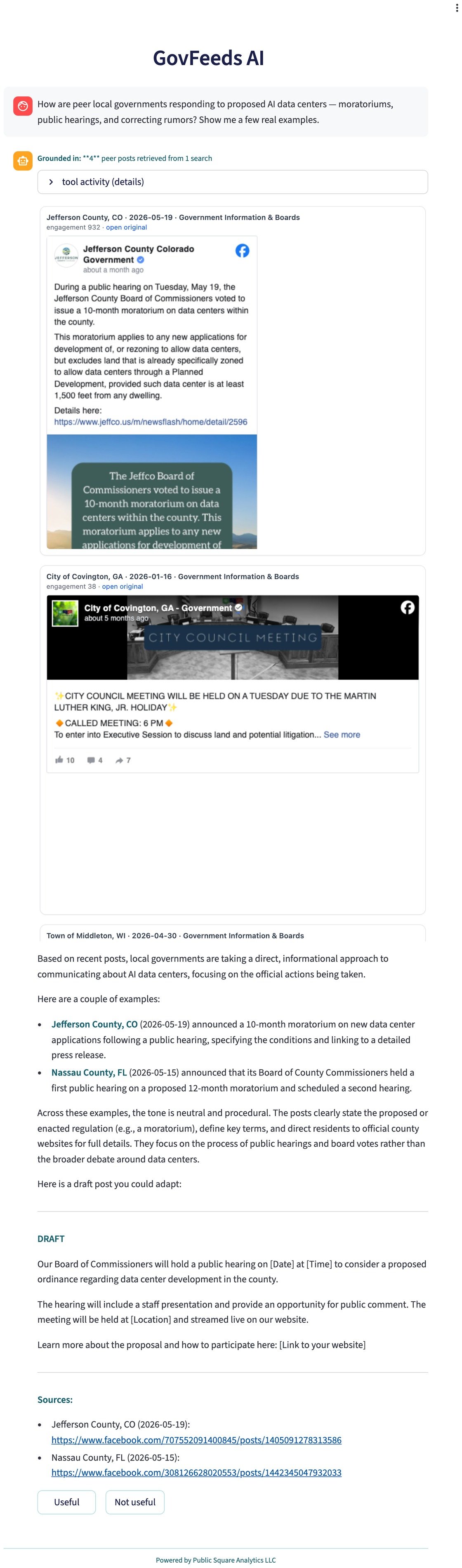
That’s the difference between a generic AI tool and one built for this job. A general chatbot will happily invent a “typical” city AI policy; GovFeeds AI shows you the one Galena, Maryland actually adopted last month. When the topic is your community’s trust, grounded in real examples isn’t a nice-to-have — it’s the whole point.
Try it on your own community — free.
Start a free 14-day trial, search the same 959,000-post dataset behind this report, and let GovFeeds AI draft your first grounded post in minutes.
No credit card required · no sales call.