#CityHallSelfie Day 2026: 248 Governments, and the Best-Performing Post Most of Them Will Publish All Year
On Tuesday, August 11, local government employees across the country stood in front of their city halls and took a picture. We measured what happened next. Across 403 posts from 248 city and county governments, the typical #CityHallSelfie post earned four times its own page’s normal engagement — and 85% of participating governments beat their own median. That is the largest lift we have measured for any kind of local-government content, and it comes from the cheapest post on the calendar.
- 248 governments took part, publishing 403 posts — 82% of them on the day itself.
- A selfie post earned a median 40 interactions vs 7 for everything else published that fortnight. Against each government’s own typical post: 4.00×, and 85% beat their own median.
- It is the most reliably-liked thing local government posts: 99.1% drew at least one like, and 65.5% drew a comment (vs 31.9% normally).
- Participation more than doubled year over year — 2.1% of active governments in 2025, 5.5% in 2026.
- Georgia is the runaway leader: 40.7% of its active governments participated, seven times the national rate. Its municipal association runs a statewide challenge.
In this recap: What happened · Why it out-performs everything · The Georgia effect · Seven posts worth stealing from · What to do with this next August · How we measured it
What happened
#CityHallSelfie Day is the invention of ELGL (Engaging Local Government Leaders), who have run it every August since 2017. The premise is deliberately low-effort: take a selfie at your city hall, post it, tag it. No budget, no campaign, no agency.
In our corpus it arrives as a single sharp spike and then vanishes:
A handful of governments warm up in the preceding days — 15 posted on the 10th, mostly “tomorrow is…” reminders — then 332 posts land on the day itself, and 26 trickle in on the 12th from the teams that missed it. There is no long tail. This is a one-day event that behaves like one.
The growth is real, and it is worth stating carefully. Raw counts jumped from 44 posts in 2025 to 408 in 2026, but our own corpus grew enormously over the same period, so raw counts overstate it. The honest measure is the participation rate among governments we were already watching: 2.1% in 2025, 5.5% in 2026. Still a near-tripling — but a quarter of the headline number.
Why it out-performs everything
We have measured a lot of content types against a baseline: video (2.1× a page’s own median), data-center posts (2.5×), rumor corrections (1.3×). City Hall Selfie Day beats all of them.
Two numbers deserve attention. The first is 99.1% like-rate — essentially every selfie post got a reaction, against 86.3% for normal content. The second is the 65.5% comment rate, more than double the norm. Residents don’t just approve of these; they reply, usually to name someone they recognize.
Within each government’s own page — the strictest comparison, since it controls for audience size and general competence — the median selfie post ran at 4.00× that page’s typical engagement, and 85% of participants beat their own median. For a post that costs one person five minutes and a phone, there is nothing else in our data with that return.
The Georgia effect
National participation was 5.5% of active governments. Georgia’s was 40.7%.
Fifty Georgia governments posted — the most of any state, from a state that isn’t close to the largest in our data. The reason is visible in the posts themselves: many carry #GMA alongside the ELGL tag, because the Georgia Municipal Association runs a statewide City Hall Selfie challenge with a leaderboard, explicitly pitched as reclaiming a top spot.
That is the most transferable finding in this report, and it has nothing to do with selfies. A state association turning a national hashtag into a state competition roughly septupled participation. Alabama (20.5%), Arizona (21.4%), Kansas (17.0%) and Missouri (16.5%) also run well above the national rate; North Carolina, with more active governments than Georgia, managed 5.9%.
The other structural pattern: this is a city event. 235 of the 248 participants were municipalities; only 12 counties took part. The name does most of that work — counties have courthouses and administration buildings, not city halls.
Seven posts worth stealing from
All screenshots are the live Facebook posts, with the engagement each one displays. Click any to open the original.
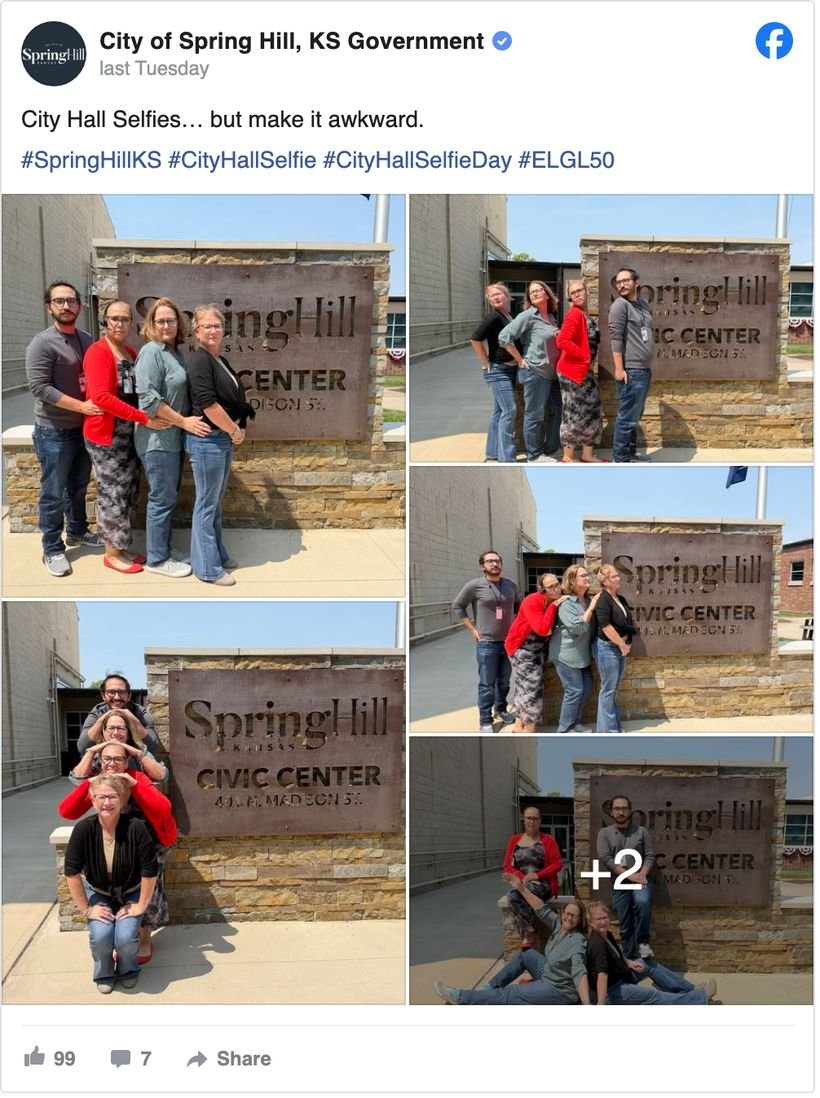
The best caption of the day, and the highest relative performance in our top set: 19.5× this page’s typical engagement. Leaning into the awkwardness of a staff selfie is more disarming than staging a good one — and it gives employees permission to participate without being photogenic.
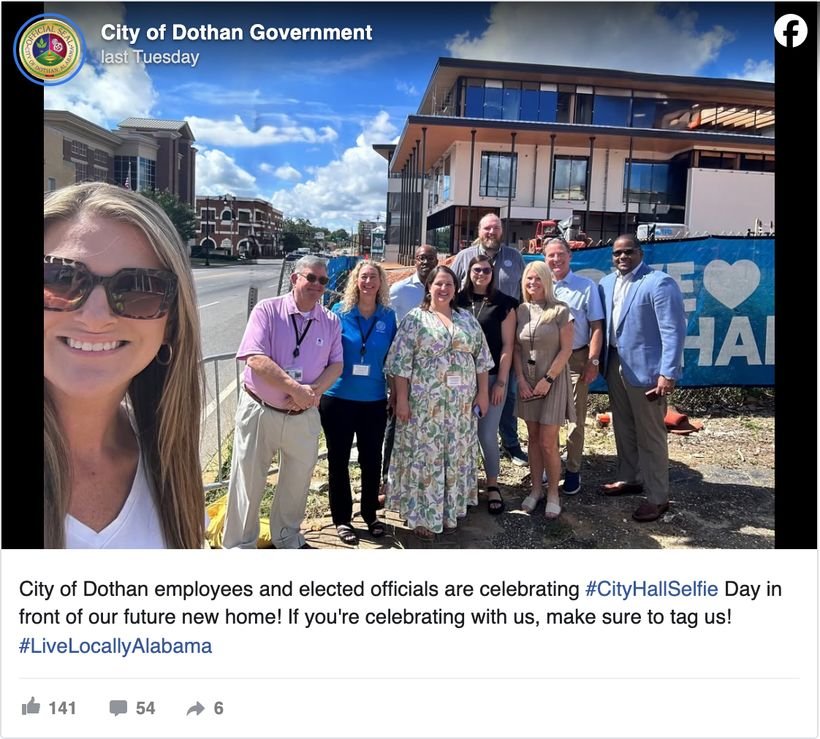
Employees and elected officials photographed “in front of our future new home” — turning a hashtag day into a construction-progress update. 141 reactions and 54 comments, roughly 24× the page’s norm. The selfie is the vehicle; the new city hall is the story.
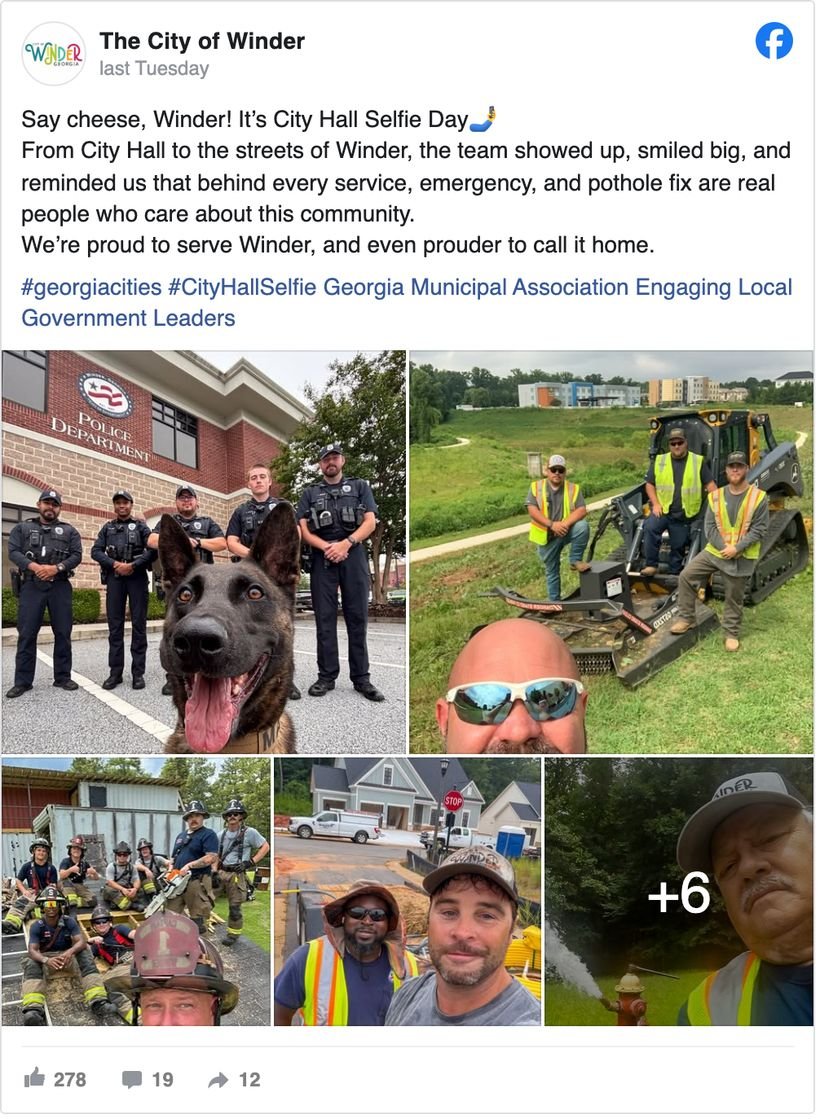
“From City Hall to the streets of Winder” — a photo set spanning departments rather than a single lobby shot, with 278 reactions. Georgia’s participants were noticeably more likely to run multi-photo albums covering field crews, not just the front desk.
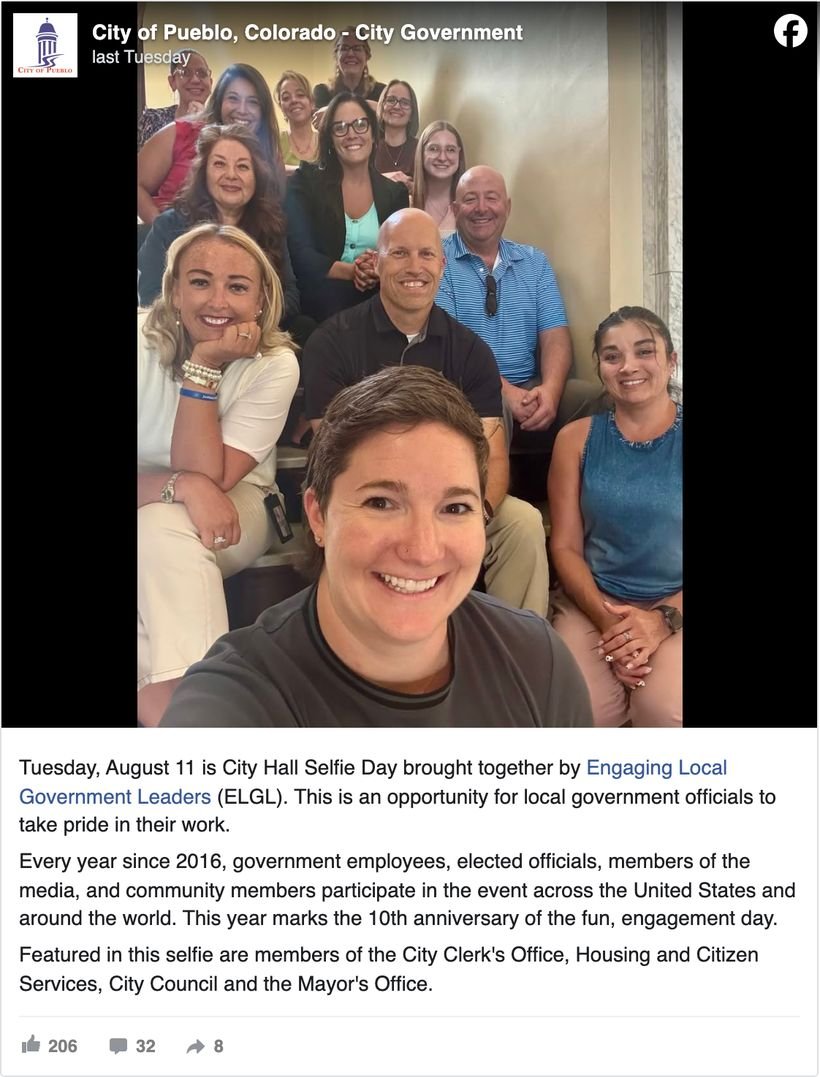
The single highest-engagement selfie post in our data: 206 reactions, 32 comments, about 23× the page’s median. The caption credits ELGL and then lists exactly which offices are pictured — City Clerk, Housing and Citizen Services, Council, Mayor. Naming departments gives every one of those teams a reason to share it.
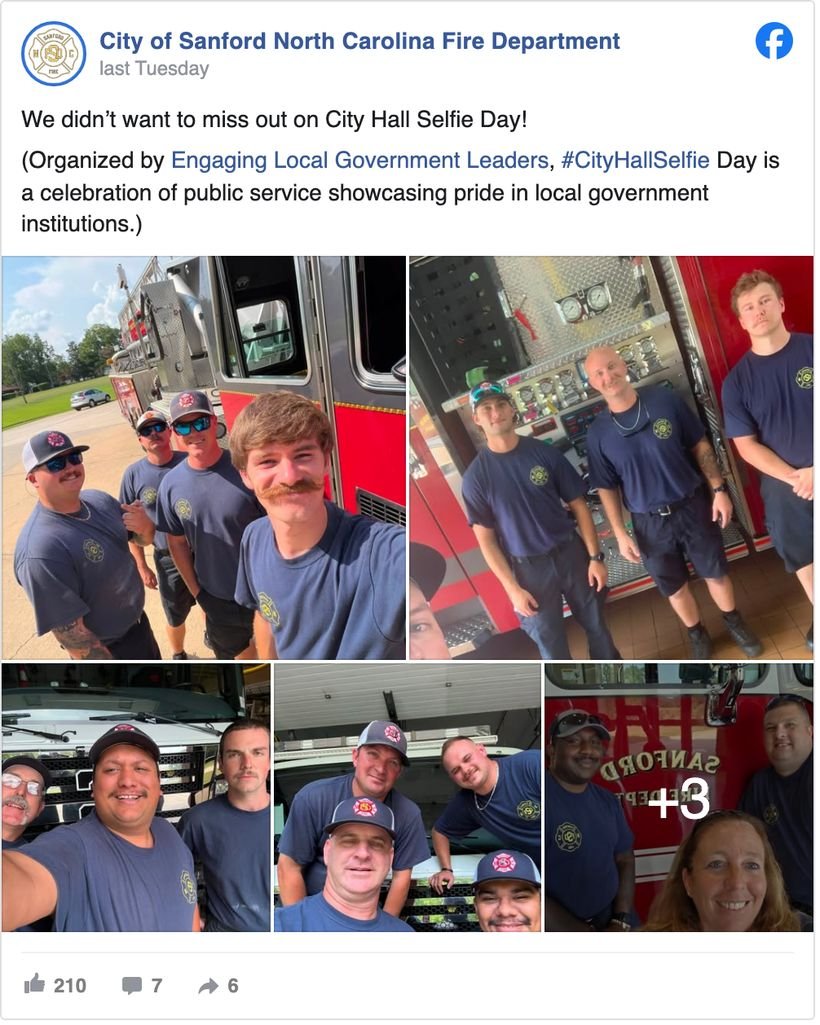
Sanford appears twice in the day’s top posts: once from the city page, once from the fire department (“We didn’t want to miss out…”), which pulled 210 reactions on its own. One coordinated day, several accounts, several audiences — more total reach than any single post could manage.
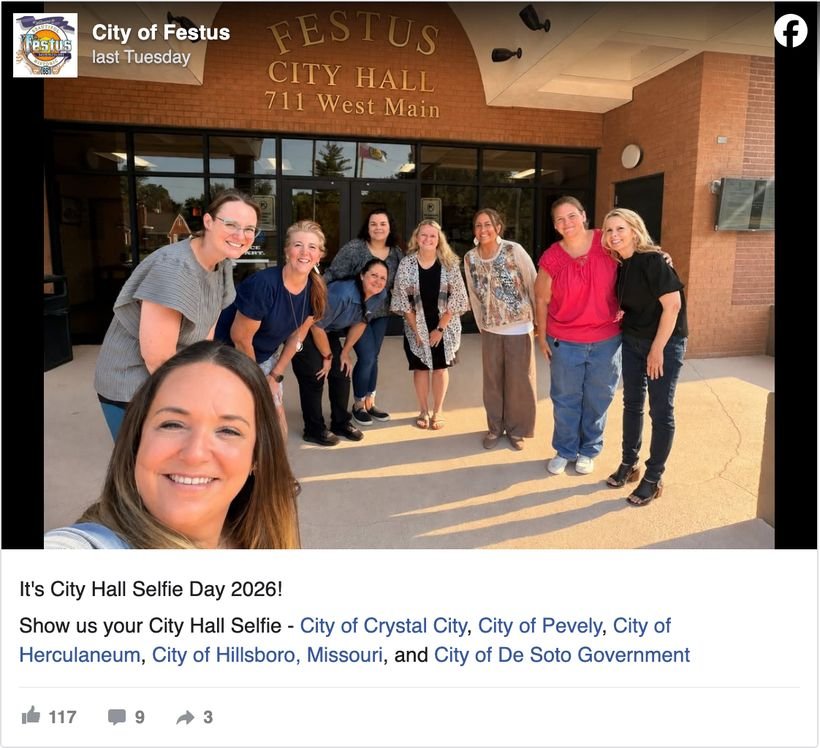
“Show us your City Hall Selfie” — tagging Crystal City, Pevely, Herculaneum, Hillsboro and De Soto directly. This is the mechanic behind the Georgia numbers, executed by one city: a challenge to named peers converts a solo post into a regional chain.
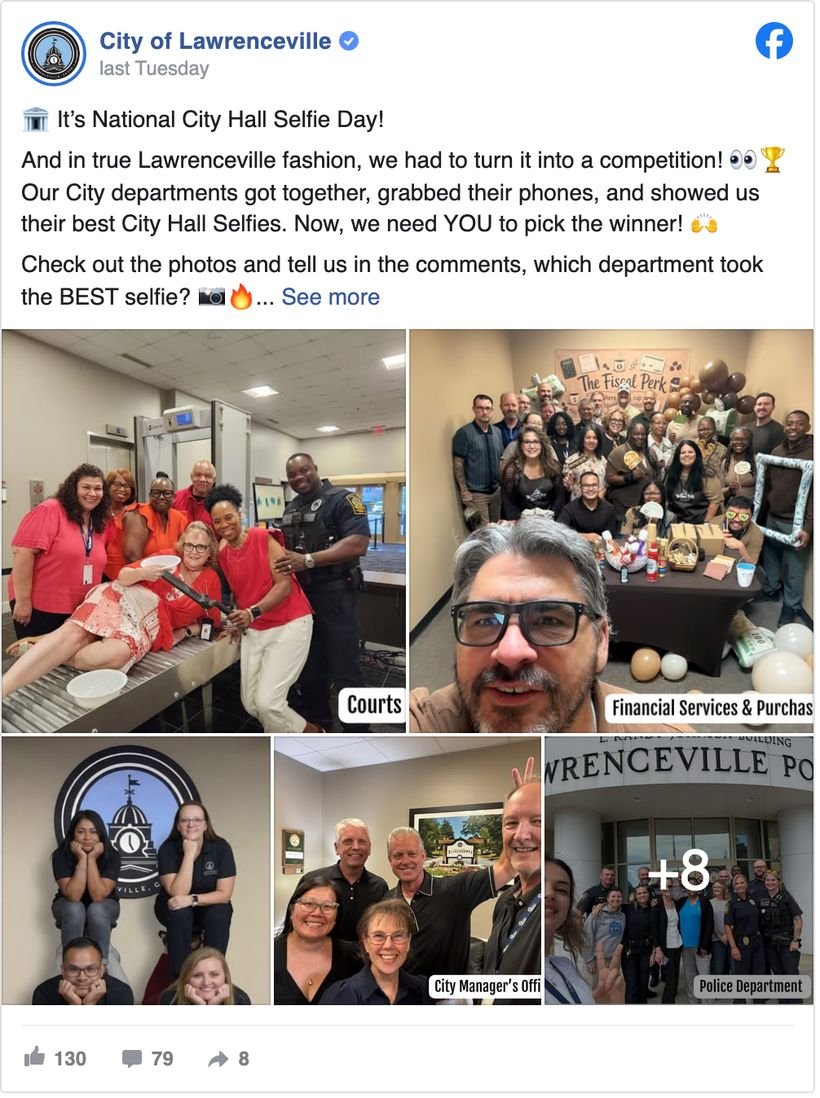
“And in true Lawrenceville fashion, we had to turn it up…” — 130 reactions and 79 comments. The highest comment counts of the day went to posts with a recognizable local voice rather than a generic template. The hashtag is national; the joke has to be local.
What to do with this next August
#CityHallSelfie Day 2027 will land in mid-August. Six things the 2026 data suggests, in rough order of payoff:
- Put it on the calendar now. 82% of the value landed on a single day, and the governments that missed it mostly posted a thin day-late version. This is a diary entry, not a strategy.
- Get your association involved. The Georgia result — 40.7% against a 5.5% national rate — is the largest single effect in this report, and it came from a state association running a leaderboard. If you sit on a state municipal association committee, this is a nearly free win.
- Tag your neighbors by name. Festus did in one post what GMA did statewide. Naming five nearby cities costs nothing and visibly propagates.
- Let every department post its own. Sanford’s fire department out-performed the main city page. Public works, parks, the library, the water plant — each has an audience that doesn’t overlap much with yours.
- Name the people and the offices in the caption. The top posts credit specific teams. That is what turns a photo into something colleagues and their families share.
- Attach it to something real if you can. A new building, an anniversary, a retirement. Dothan’s worked because the selfie carried news.
And the wider lesson, which holds well beyond one hashtag: the single most reliable content in local government is the people who work there. Our topic rankings and video analysis keep landing in the same place, and this is the cleanest demonstration of it we have — 85% of participants beat their own median with a phone photo and a caption.
How we measured this
Every number comes from public posts any resident could see.
Frequently asked questions
When is City Hall Selfie Day?
It is run each August by ELGL (Engaging Local Government Leaders). In 2026 it fell on Tuesday, August 11; in 2025 it was Tuesday, August 12. ELGL announces the date and publishes a toolkit each summer at elgl.org.
How many local governments take part in City Hall Selfie Day?
In 2026 we recorded 403 posts from 248 U.S. city and county governments on Facebook — 5.5% of the 4,496 governments active in that window, up from 2.1% in 2025. Participation is overwhelmingly municipal: 235 cities versus 12 counties. Georgia led every state at 40.7% of its active governments.
Do City Hall Selfie posts actually get engagement?
They are the strongest-performing format we have measured. The median selfie post earned 40 interactions against 7 for everything else published in the same fortnight, and against each government's own typical post it ran at 4.00× the page median, with 85% of participants beating their own median. 99.1% drew at least one like and 65.5% drew a comment, versus 31.9% normally. The participating governments are self-selected, so read it as what a well-executed people-first post earns rather than a guarantee.
Why did Georgia have so many City Hall Selfie posts?
The Georgia Municipal Association runs a statewide City Hall Selfie challenge with a leaderboard, and many Georgia posts carry #GMA alongside the ELGL hashtag. The effect is large: 40.7% of Georgia's active governments participated against a 5.5% national rate — roughly seven times. It is the clearest evidence in our data that a state association can multiply participation in a national campaign.
See what worked for governments like yours.
Search what 5,000+ peer cities and counties actually posted — by keyword, state, and population band.
“An exceptional way for people to look for ideas and comparisons.”